






 9S62
9S62
Galectin-3 in complex with N-[4-O-(beta-d-Galactopyranosyl)-beta-d-glucopyranosyl]-N-(3-carboxyphenyl)acetamide
This is a non-PDB format compatible entry.
Summary for 9S62
| Entry DOI | 10.2210/pdb9s62/pdb |
| Descriptor | Galectin-3, beta-D-galactopyranose-(1-4)-1,5-anhydro-D-glucitol, 3-acetamidobenzoic acid, ... (4 entities in total) |
| Functional Keywords | sugar binding protein, complex |
| Biological source | Homo sapiens (human) |
| Total number of polymer chains | 1 |
| Total formula weight | 16337.71 |
| Authors | Pachl, P. (deposition date: 2025-07-30, release date: 2025-11-19, Last modification date: 2025-12-10) |
| Primary citation | Zyka, J.,Kozak, J.,Vanekova, L.,Pimkova Polidarova, M.,Prouza, V.,Habanova, N.,Strmen, T.,Zavrel, M.,Pachl, P.,Choutka, J.,Grantz Saskova, K.,Brazdova, A.,Parkan, K.,Pohl, R. N -Aryl- N -Lactosylamides as Potent and Highly Selective Inhibitors of Galectin-3 with Antifibrotic Activity. J.Med.Chem., 68:24624-24648, 2025 Cited by PubMed Abstract: Galectin-3 (Gal-3) is a galactose-binding lectin involved in pathologies such as inflammation, fibrosis, heart disease, and tumor progression. Here, we report -aryl--(thio)lactosylamides as a novel class of Gal-3 inhibitors. A structure-activity study identified 6-carboxyindol-4-yl amide as a key pharmacophoric motif within this series. The most potent inhibitor based on this motif, compound , binds to Gal-3 with excellent affinity ( = 5.7 nM) and selectivity (390-fold over Gal-1). Further in vitro characterization of this compound demonstrated high metabolic stability and no cytotoxicity (CC > 300 μM). Compound effectively engages Gal-3 with greater activity in macrophage-like than monocyte-like THP1 cells, without affecting inflammation via LPS-induced release of TNFα. In TGFβ-stimulated LX2 hepatic stellate cells, it downregulates profibrotic signaling as assessed by the reduced expression of , , and . These findings implicate compound as a promising candidate for further preclinical development in the context of fibrotic disease. PubMed: 41217252DOI: 10.1021/acs.jmedchem.5c02604 PDB entries with the same primary citation |
| Experimental method | X-RAY DIFFRACTION (1.059 Å) |
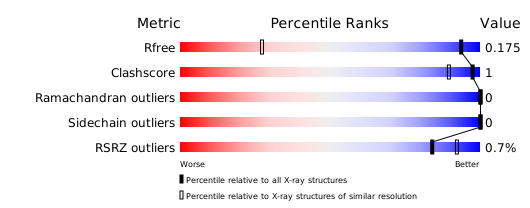
Structure validation
Download full validation report


