






 9S3O
9S3O
Cerebellar GluA2/4 NTD heterophilic tetramer interface (focused refinement)
Summary for 9S3O
| Entry DOI | 10.2210/pdb9s3o/pdb |
| EMDB information | 54543 |
| Descriptor | Glutamate receptor 4, Glutamate receptor 2, 2-acetamido-2-deoxy-beta-D-glucopyranose (3 entities in total) |
| Functional Keywords | ampa ionotropic glutamate receptor, signaling protein |
| Biological source | Sus scrofa (pig) More |
| Total number of polymer chains | 2 |
| Total formula weight | 189524.04 |
| Authors | Sengupta, N.,Scrutton, A.,Greger, I.H.,Krieger, J.M. (deposition date: 2025-07-24, release date: 2025-12-24, Last modification date: 2026-04-08) |
| Primary citation | Scrutton, A.M.,Sengupta, N.,Ivica, J.,Stockwell, I.,Peak-Chew, S.,Singh, B.,Suzuki, K.,Chang, V.T.,McLaughlin, S.H.,Krieger, J.M.,Aricescu, A.R.,Greger, I.H. Structure and organization of AMPA receptor-TARP complexes in the mammalian cerebellum. Science, 391:1361-1367, 2026 Cited by PubMed Abstract: AMPA receptors (AMPARs) are multimodal transducers of glutamatergic signals throughout the brain. Their diversity is exemplified in the cerebellum; at afferent synapses, AMPARs mediate high-frequency excitation, whereas in Bergmann glia (BG) they support calcium transients that modulate synaptic transmission. This spectrum arises from different combinations of core subunits (GluA1-4), auxiliary proteins, and post-transcriptional modifications. Here, using mass-spectrometry, cryo-EM, and electrophysiology, we characterize major cerebellar AMPARs in pig: calcium-impermeable GluA2/A4 heteromers with four TARP subunits, mainly neuronal in origin, and BG-specific calcium-permeable GluA1/A4 heteromers containing two Type-2 TARPs. We also showed that GluA4 receptors consistently exhibit compact N-terminal domains that promote their synaptic delivery. Our study defines the organizational principles of mammalian cerebellar AMPAR complexes and reveals how different receptor subtypes support cell-type specific functions. PubMed: 41379938DOI: 10.1126/science.aeb3577 PDB entries with the same primary citation |
| Experimental method | ELECTRON MICROSCOPY (3.9 Å) |
Structure validation
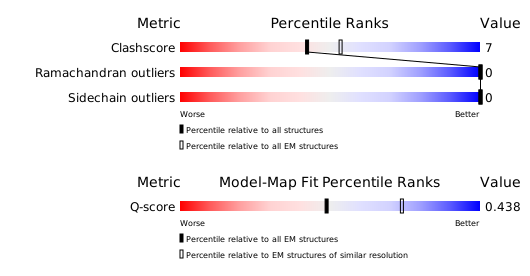
Download full validation report


