






 9S27
9S27
Crystal structure of human SIRT3 in complex with the covalent adduct of peptide triazole inhibitor LTDi1 and ADP-ribose
This is a non-PDB format compatible entry.
Summary for 9S27
| Entry DOI | 10.2210/pdb9s27/pdb |
| Descriptor | NAD-dependent protein deacetylase sirtuin-3, mitochondrial, TNFa-derived lysine triazole dodecyl inhibitor, ZINC ION, ... (6 entities in total) |
| Functional Keywords | sirtuins, mechanistic inhibitor, deacetylation, covalent adduct, hydrolase |
| Biological source | Homo sapiens (human) More |
| Total number of polymer chains | 2 |
| Total formula weight | 33179.42 |
| Authors | Friedrich, F.,Meleshin, M.,Einsle, O.,Schutkowski, M.,Jung, M. (deposition date: 2025-07-21, release date: 2025-11-12, Last modification date: 2026-01-14) |
| Primary citation | Friedrich, F.,Meleshin, M.,Papenkordt, N.,Gaitzsch, L.,Prucker, I.,Borso, M.,Ruprecht, J.,Vorreiter, C.,Rast, S.,Zhang, L.,Schiedel, M.,Sippl, W.,Imhof, A.,Jessen, H.J.,Einsle, O.,Schutkowski, M.,Jung, M. From Pharmacophore to Warhead: NAD + -Targeting Triazoles as Mechanism-Based Sirtuin Inhibitors. Angew.Chem.Int.Ed.Engl., 64:e16782-e16782, 2025 Cited by PubMed Abstract: Sirtuins (SIRTs) are nicotinamide adenine dinucleotide (NAD)-dependent lysine deacylases linked to key physiological and disease processes. Here, we report a new class of mechanism-based 1,2,3-triazole inhibitors that hijack SIRT catalysis by forming stalled triazolium- or triazole-ADP-ribose (ADPR) adducts derived from the cofactor NAD. These trapped adducts inhibit the enzyme without covalent protein modification, prompting us to term the compounds "Sirtuin Trapping Ligands" (SirTraps). X-ray crystallography and kinetics, together with mass spectrometry confirming adduct formation both in vitro and in cellulo, reveal that the triazole N3 of peptide- and small-molecule-based SirTraps triggers nucleophilic attack at C1' of the nicotinamide riboside moiety of NAD⁺, mimicking the first deacylation step. Adduct formation critically depends on precise triazole positioning within the acyl-lysine channel and can be tuned through scaffold design, enabling potent and isoform-selective inhibition. Unlike thiocarbonyl-based NAD⁺-targeting SIRT inhibitors, which may suffer from instability and off-target effects, SirTraps combine high stability, synthetic accessibility, and structural tunability, while demonstrating nanomolar cellular target engagement confirmed by NanoBRET assays. Beyond SIRTs, this inhibition strategy may extend to other NAD⁺-dependent enzymes, including ADP-ribosyltransferases, opening new avenues for mechanism-driven drug discovery. PubMed: 41165483DOI: 10.1002/anie.202516782 PDB entries with the same primary citation |
| Experimental method | X-RAY DIFFRACTION (1.6 Å) |
Structure validation
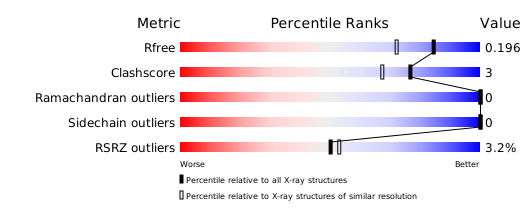
Download full validation report


