






 9RTK
9RTK
Crystal structure of Cryptosporidium parvum Thioredoxin Reductase in complex with mono-carbene Au(I) complex Au(NHC)Cl
Summary for 9RTK
| Entry DOI | 10.2210/pdb9rtk/pdb |
| Descriptor | Thioredoxin reductase, FLAVIN-ADENINE DINUCLEOTIDE, GOLD ION, ... (4 entities in total) |
| Functional Keywords | thioredoxin reductase, flavoprotein |
| Biological source | Cryptosporidium parvum |
| Total number of polymer chains | 4 |
| Total formula weight | 229131.71 |
| Authors | Gabriele, F.,Palerma, M.,Ardini, M.,Bogard, J.,Ippoliti, R.,Williams, D.L.,Angelucci, F. (deposition date: 2025-07-02, release date: 2026-06-03, Last modification date: 2026-06-10) |
| Primary citation | Gabriele, F.,Palerma, M.,Bogard, J.,Paluzzi, L.,Zineddu, S.,Geri, A.,Vitali, V.,Massai, L.,Ardini, M.,Bellelli, A.,Petukhov, P.A.,Ippoliti, R.,Messori, L.,Williams, D.L.,Angelucci, F. Gold-containing compounds target an apicomplexan Thioredoxin reductase: Disclosing reactivity through structural and functional characterization. Int.J.Biol.Macromol., 369:152627-152627, 2026 Cited by PubMed Abstract: Cryptosporidium spp. cause cryptosporidiosis, a severe diarrheal disease, particularly in young children and immunocompromised individuals. Treatment options are limited, and the only approved drug, nitazoxanide, is poorly effective in the most susceptible populations. Cryptosporidium relies exclusively on the thioredoxin reductase/thioredoxin (TrxR/Trx) system for redox homeostasis as Cryptosporidium lacks a glutathione reductase gene. Consistent with this vulnerability, TrxR ablation blocks parasite proliferation and sexual development, identifying TrxR as an essential drug target. C. parvum TrxR (CpTrxR) contains two redox-active cysteine motifs: a conserved N-terminal site and an apicomplexan-specific C-terminal site absent in human TrxRs. Here, by employing six structurally diverse gold-containing compounds, including clinically used agents, we probed the reactivity of CpTrxR toward these pharmacologically relevant chemotypes. Through a combination of X-ray crystallography, mass spectrometry, and functional studies, we discovered that enzyme inhibition arises from the distinct chemical properties of these compounds, which enable them to target either the N-terminal or the apicomplexan-specific C-terminal redox sites. These findings reinforce the potential of CpTrxR as a chemically tractable and parasite-selective target and establish gold-based scaffolds as a promising foundation for developing novel anti-Cryptosporidium therapeutics. PubMed: 42162589DOI: 10.1016/j.ijbiomac.2026.152627 PDB entries with the same primary citation |
| Experimental method | X-RAY DIFFRACTION (2.2 Å) |
Structure validation
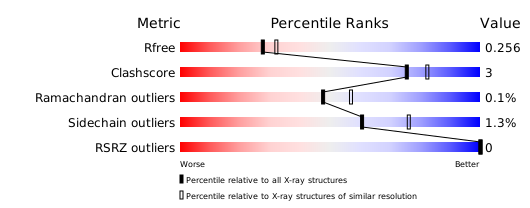
Download full validation report


