






 9RPK
9RPK
Apo structure of Arabidopsis thaliana nicotinate mononucleotide adenylyltransferase
Summary for 9RPK
| Entry DOI | 10.2210/pdb9rpk/pdb |
| Descriptor | Nicotinamide/nicotinic acid mononucleotide adenylyltransferase, SODIUM ION (3 entities in total) |
| Functional Keywords | nad metabolism, namn, arabidopsis thaliana, namnat, transferase |
| Biological source | Arabidopsis thaliana (thale cress) |
| Total number of polymer chains | 1 |
| Total formula weight | 29860.07 |
| Authors | Sorci, L.,Cianci, M.,Fortunato, C.,Gasparrini, M.,Raffaelli, N. (deposition date: 2025-06-25, release date: 2025-11-05) |
| Primary citation | Sorci, L.,Cianci, M.,Fortunato, C.,Gasparrini, M.,Raffaelli, N. Arabidopsis thaliana nicotinate mononucleotide adenylyltransferase: unveiling the molecular determinants and evolutionary origin of nicotinic acid mononucleotide recognition. Int.J.Biol.Macromol., 331:148370-148370, 2025 Cited by PubMed Abstract: The pyridine nucleotide adenylyltransferase (PNAT) enzyme family is crucial for the synthesis of NAD, a pivotal cofactor in cellular metabolism. PNATs catalyze the transfer of an AMP moiety from ATP to either nicotinate mononucleotide (NaMN), forming nicotinate adenine dinucleotide, the immediate precursor to NAD, or to nicotinamide mononucleotide (NMN), directly yielding NAD. This enzyme family exhibits modular substrate specificity, comprising strictly NaMN-selective (bacterial NadD), NMN-selective (bacterial NadR and NadM), or bifunctional (mammalian PNAT and archaeal NadM). While Arabidopsis thaliana PNAT has been ambiguously annotated as bifunctional, our detailed kinetic analysis definitively establishes its strict NaMN preference, analogous to bacterial NadD. By integrating bioinformatics and X-ray crystallography of the enzyme in its apo and NaMN-bound forms, we elucidate the structural basis for NaMN selectivity, which differs from bacterial NadD. In plants, a positively charged residue (Arg106 in A. thaliana NaMN adenylyltransferase, NaMNAT) ensures NaMN specificity by counteracting the negative charge of the nicotinate moiety. Site-directed mutagenesis confirms the essential role of Arg106 in NaMN recognition and catalysis. Our findings support the extension of this functional assignment across Archaeoplastida. Furthermore, phylogenetic analysis reveals the complex and intertwined evolution of bacterial and plant NaMNATs, shaped by ancient gene transfers from cyanobacteria. PubMed: 41109367DOI: 10.1016/j.ijbiomac.2025.148370 PDB entries with the same primary citation |
| Experimental method | X-RAY DIFFRACTION (2.15 Å) |
Structure validation
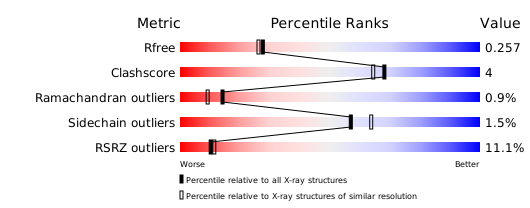
Download full validation report


