






 9ROG
9ROG
Human alpha3 Na+,K+-ATPase in the Na+-occluded E1P-ADP state obtained under turnover conditions
Summary for 9ROG
| Entry DOI | 10.2210/pdb9rog/pdb |
| EMDB information | 54118 |
| Descriptor | Sodium/potassium-transporting ATPase subunit alpha-3, Sodium/potassium-transporting ATPase subunit beta-1, Phospholemman, ... (9 entities in total) |
| Functional Keywords | active ion transport, p-type atpase, na/k-atpase, e1p, membrane protein, metal transport |
| Biological source | Homo sapiens (human) More |
| Total number of polymer chains | 3 |
| Total formula weight | 160228.89 |
| Authors | Christensen, M.E.,Habeck, M.,Katz, A.,Fruergaard, M.U.,Karlish, S.J.D.,Nissen, P. (deposition date: 2025-06-20, release date: 2026-08-12, Last modification date: 2026-09-09) |
| Primary citation | Christensen, M.E.,Habeck, M.,Katz, A.,Fruergaard, M.U.,Peleg, Y.,Pick, U.,Karlish, S.J.D.,Nissen, P. Active conformations of neuronal Na + , K + -ATPase isoforms and a disease-causing mutant. Nat Commun, 17:-, 2026 Cited by PubMed Abstract: Na,K-ATPases establish and maintain the vital electrochemical gradients for Na and K across animal cell membranes. The protein is a ternary complex composed of α, β and FXYD subunits, of which isoforms that fine-tune transport properties are expressed in a tissue-specific fashion. Here we report cryo-EM structures under active ATPase turn-over conditions of the ubiquitously expressed human α1β1FXYD1 and neuron-specific α3β1FXYD1 isoform complexes and probe their specific functional and biophysical properties. The data provides an extensive insight into Na-transport of ATP-activated enzyme through four distinct conformational states, including a sodium-bound phosphoenzyme intermediate, denoted [Na]E2P. This conformation reveals a crucial structural change that precedes Na release in the inward to outward (E1P-E2P) transition, within the general context of the sequential, active transport mechanism. We discuss the mechanism of the physiologically important differentiation in Na affinity of α3 compared to α1, the co-operative Na binding at the ion-binding sites, and the mechanistic aspects of cytoplasmic ion gating and extracellular Na release. Finally we present the structures of a disease-causing mutant form of α3, associated with Alternating Hemiplegia of Childhood (Q140L). The mutation compromises a specific phospholipid-binding pocket and impedes polyunsaturated phospholipid-mediated stimulation of Na,K-ATPase activity. PubMed: 42669691DOI: 10.1038/s41467-026-75997-4 PDB entries with the same primary citation |
| Experimental method | ELECTRON MICROSCOPY (2.8 Å) |
Structure validation
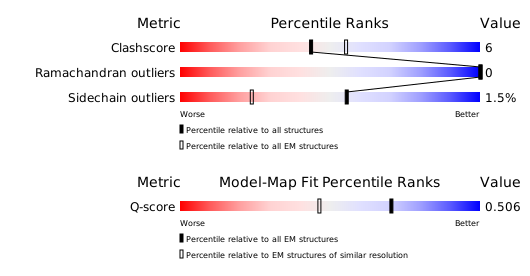
Download full validation report


