






 9RI2
9RI2
Crystal structure of bacillithiol methyltransferase NmbA from Chlorobaculum tepidum
Summary for 9RI2
| Entry DOI | 10.2210/pdb9ri2/pdb |
| Descriptor | Methyltransferase, putative, 2-[3-(2-HYDROXY-1,1-DIHYDROXYMETHYL-ETHYLAMINO)-PROPYLAMINO]-2-HYDROXYMETHYL-PROPANE-1,3-DIOL, CITRATE ANION, ... (4 entities in total) |
| Functional Keywords | natural product methyl transferase, low-molecular weight thiol, bacillithiol, sam, transferase |
| Biological source | Chlorobaculum tepidum TLS |
| Total number of polymer chains | 2 |
| Total formula weight | 61691.05 |
| Authors | Hammerstad, M.,Hersleth, H.-P. (deposition date: 2025-06-10, release date: 2025-12-10, Last modification date: 2025-12-17) |
| Primary citation | Hammerstad, M.,Steinvik, E.,Hersleth, H.P. The methyltransferase NmbA methylates the low-molecular weight thiol bacillithiol, and displays a specific structural architecture. Redox Biol, 88:103937-103937, 2025 Cited by PubMed Abstract: Low-molecular-weight (LMW) thiols maintain the cellular redox balance and protect cells against reactive species, heavy metals, toxins, and antibiotics. Despite having similar metabolic functions, structurally distinct LMW thiols are widespread in nature, with bacillithiol (BSH) being the predominant LMW thiol in bacteria. The LMW thiol N-methyl-BSH (N-Me-BSH) has been identified in the green sulfur bacterium Chlorobaculum tepidum, revealing the presence of a putative S-adenosyl-l-methionine (SAM)-dependent methyltransferase (MT), NmbA, which could catalyze the final biosynthetic step of N-Me-BSH. In this study, we report biochemical evidence for NmbA's specific function as an MT of the N-atom of the BSH cysteine moiety. We also present the crystal structure of NmbA, confirming that NmbA is a Class I SAM-dependent MT, however, displaying a unique three-dimensional architecture that differs from those of other natural product MTs (NPMTs). The NmbA active site has a narrow molecular basket structure resulting from an unusual organization of the variable Cap domain, and our docking calculations suggests that it can specifically accommodate the BSH substrate. Our research provides a valuable overview of the phylogenetic distribution of N-Me-BSH in bacteria, alongside essential functional and structural insight into a new class of N-directed NPMTs. These findings contribute to the field of SAM-dependent MTs and may allow for targeting distinct bacterial defense mechanisms involving LMW thiols with potential environmental, biotechnological, and medical implications. PubMed: 41338164DOI: 10.1016/j.redox.2025.103937 PDB entries with the same primary citation |
| Experimental method | X-RAY DIFFRACTION (2.7 Å) |
Structure validation
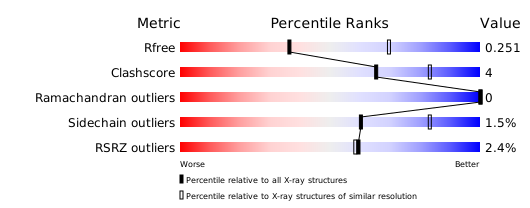
Download full validation report


