






 9RDG
9RDG
Glucuronoxylan-specific GH30_8 family xylanase CtXyn30A from Clostridium thermocellum complex with glucuronic acid epoxide inhibitor
Summary for 9RDG
| Entry DOI | 10.2210/pdb9rdg/pdb |
| Descriptor | Carbohydrate binding family 6, 4-O-methyl-alpha-D-glucopyranuronic acid-(1-2)-beta-D-xylopyranose, (1~{R},2~{S},4~{S},5~{R})-cyclohexane-1,2,3,4,5-pentol, ... (4 entities in total) |
| Functional Keywords | activity-based probes, glucuronoxylan-specific xylanases, gh30_8, covalent labelling, hydrolase |
| Biological source | Acetivibrio thermocellus DSM 2360 |
| Total number of polymer chains | 2 |
| Total formula weight | 94759.85 |
| Authors | Correa, T.L.R.,Li, Z.,Moroz, O.V.,Pickles, I.B.,Lebedev, A.A.,Akkad, S.,Willems, L.,Overkleeft, H.S.,Davies, G.J. (deposition date: 2025-06-02, release date: 2026-06-24, Last modification date: 2026-07-08) |
| Primary citation | Correa, T.L.R.,Li, Z.,Moroz, O.,Pickles, I.B.,Lebedev, A.A.,Akkad, S.,Willems, L.I.,Codee, J.D.C.,Overkleeft, H.S.,Davies, G.J. A chemoproteomic biotechnological toolkit for resolving xylanase specificity in decorated xylan. Nat Commun, 2026 Cited by PubMed Abstract: Xylanases are central to lignocellulosic biomass degradation, yet current methods lack the specificity to resolve how enzymes distinguish complex xylan structures decorated with arabinofuranose (Araf) and 4-O-methyl-glucuronic acid (MeGlcA). Here, we report a suite of chemically-defined activity-based probes (ABPs) that enable the selective detection of arabinoxylan- and glucuronoxylan-specific xylanases (AXXs and GXXs). These cyclophellitol-derived ABPs covalently label retaining xylanases at their active sites, allowing precise mapping of substrate specificity across diverse glycoside hydrolase families. Crystallographic and mass spectrometric analyses reveal the molecular basis of probe selectivity, while in-gel and pull-down assays demonstrate their effectiveness in profiling xylanase activities in complex bacterial and fungal proteomes, including cellulosomes. By integrating activity-based protein profiling (ABPP) with sequence similarity networks (SSNs), we further show that xylanase specificity can be predicted from sequence alone, enabling rapid functional annotation of uncharacterized xylanases. This chemoproteomic strategy provides a powerful platform for discovering and engineering substrate-specific enzymes for biomass valorisation, microbial ecology, and biotechnological applications. PubMed: 42331816DOI: 10.1038/s41467-026-74484-0 PDB entries with the same primary citation |
| Experimental method | X-RAY DIFFRACTION (1.5 Å) |
Structure validation
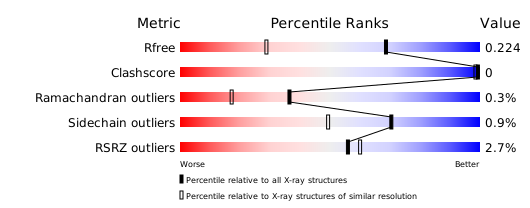
Download full validation report


