






 9RD5
9RD5
Phi3T SroF bound to DNA
Summary for 9RD5
| Entry DOI | 10.2210/pdb9rd5/pdb |
| Descriptor | DNA (26-MER), Core-binding (CB) domain-containing protein, 2-AMINO-2-HYDROXYMETHYL-PROPANE-1,3-DIOL, ... (6 entities in total) |
| Functional Keywords | recombinase, arbitrium repressor, yopr, dna binding protein |
| Biological source | Bacillus phage phi3T More |
| Total number of polymer chains | 3 |
| Total formula weight | 54417.22 |
| Authors | Zamora-Caballero, S.,Marina, A. (deposition date: 2025-06-01, release date: 2026-01-14, Last modification date: 2026-04-22) |
| Primary citation | Chmielowska, C.,Zamora-Caballero, S.,Mancheno-Bonillo, J.,Li, Y.,Sin, D.,Borenstein, T.,Bendori, S.O.,Eldar, A.,Marina, A.,Penades, J.R. A DNA recognition-mimicry switch governs induction in arbitrium phages. Cell Host Microbe, 34:291-303.e10, 2026 Cited by PubMed Abstract: Temperate phages integrate multiple information sources to regulate lysis-lysogeny transitions. SPbeta-like phages use arbitrium signaling and DNA damage to control repressor activity during lytic induction, but how the repressor functions and is inactivated by the SOS response remains unclear. Here, we show that SroF, the SPbeta-like phage repressor, binds DNA via a mechanism involving its integrase-like fold, enabling stable prophage repression. Upon DNA damage, the host SOS response triggers derepression of an antirepressor, Sar. Sar binds SroF by mimicking the DNA structure recognized by the repressor, thereby inactivating its function and inducing phage. This mechanism is conserved across SPbeta-like phages, which encode multiple, specific SroF-Sar pairs. Surprisingly, repressor inactivation alone is insufficient for efficient induction when arbitrium levels are high. Our results uncover the mechanism underlying a double layer of control that ensures phage induction occurs only under SOS conditions and in the absence of neighboring prophages. PubMed: 41619736DOI: 10.1016/j.chom.2026.01.012 PDB entries with the same primary citation |
| Experimental method | X-RAY DIFFRACTION (2.5 Å) |
Structure validation
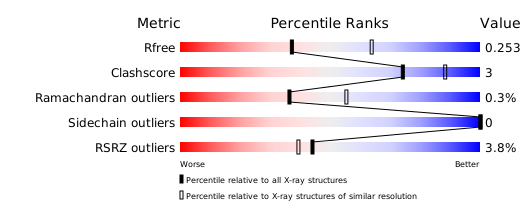
Download full validation report


