






 9R2F
9R2F
Tau filaments seeded by AD homogenate using 0N3R C322A
Summary for 9R2F
| Entry DOI | 10.2210/pdb9r2f/pdb |
| EMDB information | 53527 |
| Descriptor | Isoform Fetal-tau of Microtubule-associated protein tau (1 entity in total) |
| Functional Keywords | mapt, tau, alzheimer's disease, rt-quic, protein fibril |
| Biological source | Homo sapiens (human) |
| Total number of polymer chains | 6 |
| Total formula weight | 46853.67 |
| Authors | Lovestam, S.,Scheres, H.W.S. (deposition date: 2025-04-30, release date: 2025-06-11, Last modification date: 2025-10-22) |
| Primary citation | Santambrogio, A.,Lovestam, S.,Metrick the Second, M.A.,Lohr, T.,Xu, P.,Gallagher, N.C.T.,Ghetti, B.,Caughey, B.,Scheres, S.H.W.,Vendruscolo, M. Serial amplification of tau filaments using Alzheimer's brain homogenates and C322A or C322S recombinant tau. Febs Lett., 599:2768-2778, 2025 Cited by PubMed Abstract: The assembly of tau into amyloid filaments is a hallmark of Alzheimer's disease (AD) and other tauopathies. Cryo-EM revealed the existence of disease-specific tau folds, which are challenging to replicate in vitro. We studied three full-length recombinant 0N3R tau forms (the wild-type and the C322A and C322S variants) using an RT-QuIC assay with brain homogenate seeding. C322A tau formed filaments resembling AD paired helical filaments (PHFs) but with a more open C-shaped core. C322S tau yielded structurally distinct filaments with an ordered C-terminal region. Both mutants seeded further aggregation, whereas the wild-type showed poor reproducibility and mainly unfolded aggregates. These results highlight the importance of optimised conditions to produce disease-relevant tau filaments and aid the development of targeted therapies. Impact statement We investigated the seeded assembly of 0N3R tau and its two mutational variants C322A and C322S, using Alzheimer's disease brain homogenates in a real-time quaking-induced conversion (RT-QuIC) assay. The C322A variant formed filaments partially resembling the AD PHF structure, showing the importance of optimised conditions to produce disease-relevant tau filaments. PubMed: 41026859DOI: 10.1002/1873-3468.70141 PDB entries with the same primary citation |
| Experimental method | ELECTRON MICROSCOPY (2.8 Å) |
Structure validation
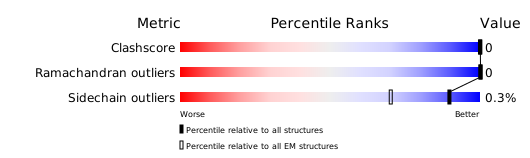
Download full validation report


