






 9QW7
9QW7
The crystal structure of the adenyly transferase domain of Candida glabrata tRNA ligase
Summary for 9QW7
| Entry DOI | 10.2210/pdb9qw7/pdb |
| Descriptor | tRNA ligase, ADENOSINE MONOPHOSPHATE, CHLORIDE ION, ... (4 entities in total) |
| Functional Keywords | trna ligase, ligase |
| Biological source | Nakaseomyces glabratus |
| Total number of polymer chains | 2 |
| Total formula weight | 90025.77 |
| Authors | McEwen, A.G.,Poussin-Courmontagne, P.,Giovinazzo, A.,Tocchini-Valentini, G.D.,Tocchini-Valentini, G.P.,Pellegrini, M.,Merolle, M. (deposition date: 2025-04-14, release date: 2025-09-17, Last modification date: 2025-12-10) |
| Primary citation | McEwen, A.G.,Giovinazzo, A.,Poussin-Courmontagne, P.,Merolle, M.,Tocchini-Valentini, G.P.,Pellegrini, M.,Tocchini-Valentini, G.D. The adaptability of the fungal tRNA ligase's ATP-binding pocket: a potential target for new antifungal drugs. Nar Mol Med, 2:ugaf028-ugaf028, 2025 Cited by PubMed Abstract: The transfer RNA (tRNA) ligase (TRL1) is a highly conserved multidomain protein that is the archetype of the recently characterized Rnl6 clade. This clade distinguishes itself through a distinct C-terminal domain that sets it apart from other RNA ligase families. TRL1 is an essential component of pre-tRNA splicing and the processing of the Ire1p (Inositol-requiring enzyme 1)-dependent noncanonical splicing of the messenger RNA (mRNA) coding for HAC-1 (Homologous to Activating Transcription Factor / cAMP Response Element-Binding Protein 1 (ATF/CREB1), a transcription factor critical for the unfolded protein response (UPR) in the kingdom of fungi. Here, we report the crystal structure of the N-terminal adenylyl transferase domain (LIG) from . The asymmetric unit contained two molecules in complex with noncovalently linked adenosine monophosphate (AMP), revealing conformational differences. In comparison to previous studies, we observe two distinct and partially overlapping ligand-binding pockets, implying new specific residues involved in ligand binding and recognition. These insights on TRL1's ligand adaptability have important implications for the development of targeted therapies. PubMed: 41306651DOI: 10.1093/narmme/ugaf028 PDB entries with the same primary citation |
| Experimental method | X-RAY DIFFRACTION (2.75 Å) |
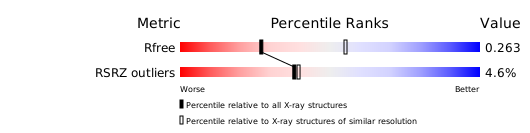
Structure validation
Download full validation report


