






 9QT2
9QT2
Bacterial histone HLp from Leptospira perolatii bound to DNA
Summary for 9QT2
| Entry DOI | 10.2210/pdb9qt2/pdb |
| Related | 9QT0 |
| Descriptor | DUF1931 domain-containing protein, DNA (5'-D(P*CP*CP*GP*TP*TP*TP*AP*AP*AP*GP*CP*CP*GP*TP*T)-3') (3 entities in total) |
| Functional Keywords | bacterial histone, protein-dna complex, dna binding protein |
| Biological source | Leptospira perolatii More |
| Total number of polymer chains | 2 |
| Total formula weight | 16343.06 |
| Authors | |
| Primary citation | Hu, Y.,Schwab, S.,Qiu, K.,Zhang, Y.,Bar, K.,Reichle, H.,Panzera, A.,Lupas, A.N.,Hartmann, M.D.,Dame, R.T.,Alva, V.,Hernandez Alvarez, B. DNA Wrapping by a tetrameric bacterial histone. Nat Commun, 16:11108-11108, 2025 Cited by PubMed Abstract: Histones are conserved DNA-packaging proteins found across all domains of life. In eukaryotes, canonical histones form octamers that wrap ~147 base pairs (bp) of DNA into nucleosomes, while in archaea they form dimers that polymerize into extended hypernucleosomes. Although bacteria were long thought to lack histones, homologs have now been identified in diverse lineages. We previously characterized the histone HBb from Bdellovibrio bacteriovorus, which binds and bends DNA as a dimer. Here, we describe HLp from Leptospira perolatii and show by crystallographic and biophysical analyses that, unlike HBb, it forms stable tetramers and binds DNA nonspecifically, wrapping ~60 bp of DNA around its core. Molecular dynamics simulations, DNA-binding assays, and heterologous expression in Escherichia coli, where HLp reorganizes the nucleoid, support a role in bacterial chromatin organization. These findings expand the repertoire of bacterial histone-DNA interactions and highlight the diversity of histone-based genome organization across the tree of life. PubMed: 41381525DOI: 10.1038/s41467-025-67425-w PDB entries with the same primary citation |
| Experimental method | X-RAY DIFFRACTION (1.9 Å) |
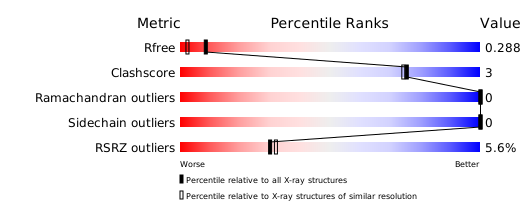
Structure validation
Download full validation report


