






 9QSJ
9QSJ
Cryo-EM structure of SKM-70S ribosomal stalled complex in the A-tRNA positioned (Body open) state.
This is a non-PDB format compatible entry.
Summary for 9QSJ
| Entry DOI | 10.2210/pdb9qsj/pdb |
| Related | 9QQQ 9SRO |
| EMDB information | 53341 |
| Descriptor | A-site tRNA-Leu, Small ribosomal subunit protein uS4, Small ribosomal subunit protein uS5, ... (59 entities in total) |
| Functional Keywords | antibiotics, 70s complex, body closure, accomodation, ribosome |
| Biological source | Escherichia coli B More |
| Total number of polymer chains | 55 |
| Total formula weight | 2238267.05 |
| Authors | Morici, M.,Corazza, M.,Safdari, H.A.,Wilson, D.N. (deposition date: 2025-04-05, release date: 2026-02-18, Last modification date: 2026-06-24) |
| Primary citation | Wright, G.,Cook, M.,Xu, M.,Morici, M.,Travin, D.,Wang, W.,Klepacki, D.,Chhabra, N.,Rao, V.,Sahile, H.,Hackenberger, D.,Safdari, H.,Berger, M.,Corazza, M.,Bond, A.,Guitor, A.,Tertigas, D.,Wang, L.,Schaenzer, A.,Ejim, L.,Yarlagadda, V.,Gomez, J.,Surette, M.,Av-Gay, Y.,Dhar, N.,Hung, D.,Vazquez-Laslop, N.,Mankin, A.,Wilson, D. Saskemycin, a potent and selective antimycobacterial agent targeting a unique site on the ribosome. Res Sq, 2025 Cited by PubMed Abstract: Tuberculosis is the deadliest bacterial disease on the planet. The months-long regimen of multiple antibiotics required to treat tuberculosis profoundly affects the microbiome and leads to the development of antimicrobial resistance. Furthermore, non-tuberculous mycobacterial infections pose an increasing clinical challenge. Consequently, there is a growing need for new narrow-spectrum mycobacteria-targeting antibiotics with different mechanisms of action. Here, we report the discovery and characterization of a natural glycolipid antibiotic, saskemycin (SKM), which demonstrates potent and highly selective activity against mycobacteria. Genome sequencing, chemical analysis, and isotope feeding strategies reveal the unique structure and biosynthetic origin of SKM. SKM binds to the small ribosomal subunit at a site not targeted by any of the clinically relevant antibiotics acting on the ribosome. Bound to the ribosome, SKM corrupts the decoding center in a unique way, preventing stable binding of aminoacyl-tRNA in the A site and inhibiting translation in a sequence context-specific manner. Self-resistance in the producing organism is conferred by methylation of a single 16S rRNA nucleotide by SasO and SasN rRNA methyltransferases. These enzymes are orthologs of the ubiquitous RsmC and SpoU methyltransferases found in most bacterial genera but absent in mycobacteria, rationalizing SKM's exquisite selectivity. The discovery of SKM provides an entry point for the development of selective, microbiome-sparing antimycobacterial antibiotics with a unique structure, binding site, and mechanism of action. PubMed: 41282059DOI: 10.21203/rs.3.rs-7820265/v1 PDB entries with the same primary citation |
| Experimental method | ELECTRON MICROSCOPY (2.62 Å) |
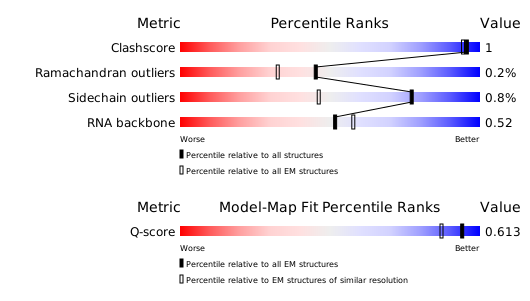
Structure validation
Download full validation report


