






 9QO8
9QO8
Inward-open structure of human GABA transporter 3 bound to selective inhibitor SR-THAP
This is a non-PDB format compatible entry.
Summary for 9QO8
| Entry DOI | 10.2210/pdb9qo8/pdb |
| Related | 9QO9 9QOA |
| EMDB information | 53259 |
| Descriptor | Sodium- and chloride-dependent GABA transporter 3, (2S, 2'R)-2-hydroxy-2-(1-((E)-4,4,4-tris(4-methoxyphenyl)but-2-en-1-yl)pyrrolidin-2'-yl)acetic acid, CHLORIDE ION, ... (4 entities in total) |
| Functional Keywords | transport protein, slc6a11, neurotransmitter/sodium symporter, sodium- and chloride-dependent gaba transporter 3, gat3, membrane protein |
| Biological source | Homo sapiens (human) |
| Total number of polymer chains | 1 |
| Total formula weight | 71213.50 |
| Authors | Mortensen, J.S.,Bavo, F.,Jensen, M.H.,Pedersen, A.P.S.,Storm, J.P.,Pape, T.,Frolund, B.,Wellendorph, P.,Shahsavar, A. (deposition date: 2025-03-25, release date: 2026-02-18, Last modification date: 2026-03-04) |
| Primary citation | Mortensen, J.S.,Bavo, F.,Jensen, M.H.,Pedersen, A.P.S.,Storm, J.P.,Pape, T.,Frolund, B.,Wellendorph, P.,Shahsavar, A. Structural basis for selective inhibition of human GABA transporter GAT3. Nat Commun, 17:1774-1774, 2026 Cited by PubMed Abstract: The astrocytic γ-aminobutyric acid (GABA) transporter, GAT3, is essential for terminating GABAergic signaling in the central nervous system. Selective inhibition of GAT3 offers a potential strategy for elevating extracellular GABA levels for the treatment of neurological disorders including epilepsy. However, few potent and selective GAT3 inhibitors have been developed, and their mechanisms of inhibition remain poorly understood. Here, we present the cryo-electron microscopy structures of full-length, wild-type human GAT3, hGAT3, bound to a selective inhibitor, to substrate GABA, or in substrate-free state. hGAT3 bound to the inhibitor or in the substrate-free state exhibits an inward-open conformation. The inhibitor binds within the intracellular permeation pathway, positioned between transmembrane helices 1, 2, 3, 6, 7, and 8. The GABA-bound hGAT3 is captured in an inward-occluded state, revealing the ion coordination and substrate recognition network, including a cation-π interaction between GABA's γ-amino group and a phenylalanine residue in transmembrane helix 6. Our data reveal the molecular determinants for the inhibitor selectivity, and the mode of substrate binding and transport inhibition, providing blueprints for the rational design of next-generation selective GAT3 inhibitors. PubMed: 41611703DOI: 10.1038/s41467-026-68479-0 PDB entries with the same primary citation |
| Experimental method | ELECTRON MICROSCOPY (2.9 Å) |
Structure validation
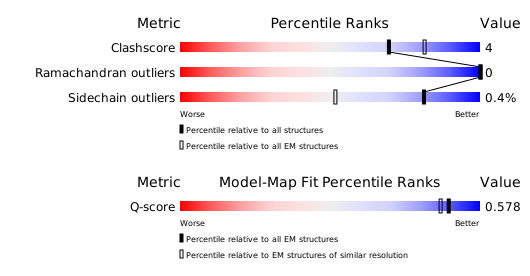
Download full validation report


