






 9QLK
9QLK
Structure of piperazate synthase from Streptomyces sp.
Summary for 9QLK
| Entry DOI | 10.2210/pdb9qlk/pdb |
| Descriptor | FMN-binding negative transcriptional regulator, PROTOPORPHYRIN IX CONTAINING FE, GLYCEROL, ... (6 entities in total) |
| Functional Keywords | piperazate synthase, piperazic acid, n-n bond formation, heme-binding, lyase |
| Biological source | Streptomyces sp. B93 |
| Total number of polymer chains | 6 |
| Total formula weight | 158104.64 |
| Authors | Pal, N.,Schroder, S.,Sagmeister, T.,Daniel, B.,Gruber, K. (deposition date: 2025-03-21, release date: 2026-04-08, Last modification date: 2026-09-09) |
| Primary citation | Pal, N.,Schroder, S.,Sahrawat, A.S.,Gruber, C.C.,Hayes, M.A.,Daniel, B.,Schmidt, S.,Gruber, K. Crystal Structure and Conformational Dynamics of N─N Bond-Forming Piperazate Synthase. Chembiochem, 27:e70430-e70430, 2026 Cited by PubMed Abstract: l-Piperazic acid (l-Piz) is a noncanonical, α-hydrazino acid characterized by a 1,2-diazinane heterocycle containing an N─N bond. It occurs in numerous natural products with potent biological activities and represents a key pharmaceutical building block. In nature, l-Piz is biosynthesized from l-ornithine via the intermediate N-hydroxy-l-ornithine in a two-enzyme cascade comprising a flavin adenine dinucleotide (FAD)-dependent N-hydroxylating monooxygenase (NMO) and a heme-dependent piperazate synthase (PZS). The NMO selectively hydroxylates the δ-amino group of l-ornithine, while PZS catalyzes intramolecular N─N bond formation to generate the six-membered cyclic hydrazine scaffold of l-Piz. Here, we report the crystal structure, Piz-forming activity, and molecular dynamics (MD) analysis of SbPZS, a representative PZS from Streptomyces sp. B93. High-resolution structural analysis enabled a detailed comparison with previously characterized PZS homologs. To further delineate the molecular basis of catalysis, we performed MD simulations in combination with sequence-based bioinformatic analyses. These studies provide insight into protein-substrate interactions, conformational dynamics, and the residues that contribute to active-site organization. Moreover, we identify candidate hotspots for engineering to modulate substrate scope and catalytic efficiency. Collectively, our results establish a structural framework for understanding enzymatic N─N bond formation in Piz biosynthesis and lay the groundwork for future biocatalytic applications of PZSs. PubMed: 42307988DOI: 10.1002/cbic.70430 PDB entries with the same primary citation |
| Experimental method | X-RAY DIFFRACTION (2.14 Å) |
Structure validation
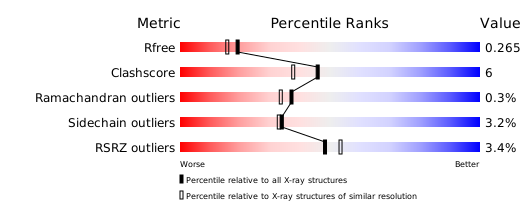
Download full validation report


