






 9QHO
9QHO
Cryo-EM structure of mouse TRPM3 alpha 2 in complex with antagonist Primidone
This is a non-PDB format compatible entry.
Summary for 9QHO
| Entry DOI | 10.2210/pdb9qho/pdb |
| EMDB information | 53175 |
| Descriptor | MKIAA1616 protein, (3beta,14beta,17beta,25R)-3-[4-methoxy-3-(methoxymethyl)butoxy]spirost-5-en, primidone, ... (4 entities in total) |
| Functional Keywords | ca2+ channel primidone-bound closed conformation, membrane protein |
| Biological source | Mus musculus (house mouse) |
| Total number of polymer chains | 4 |
| Total formula weight | 653721.19 |
| Authors | Shkumatov, A.V.,Schenck, S.,Brunner, J.D. (deposition date: 2025-03-16, release date: 2026-02-11, Last modification date: 2026-08-26) |
| Primary citation | Bazeli, B.,Shkumatov, A.V.,Schenck, S.,Vanherck, J.C.,Janssens, A.,Spieser, S.A.H.,Marchand, D.,Roelens, R.,Chaltin, P.,Marchand, A.,Vriens, J.,Voets, T.,Brunner, J.D. Stereoselectivity and functional plasticity of a common ligand-binding pocket in TRPM3. Nat Commun, 17:-, 2026 Cited by PubMed Abstract: The transient receptor potential melastatin 3 (TRPM3) channel is a key mediator of peripheral pain signaling, and pathogenic mutations in TRPM3 are linked to neurodevelopmental delay and epilepsy. Despite the therapeutic promise of TRPM3 modulators, the molecular mechanisms by which ligands modulate channel gating remain poorly understood. Here, we combine cryo-electron microscopy (cryo-EM) with functional analyses to characterize a promiscuous ligand-binding pocket formed by transmembrane helices S1-S4. This pocket accommodates several chemically diverse plant-derived and synthetic agonists and antagonists. We show stereoselectivity of TRPM3 for the (R)-enantiomer of the flavonoid antagonist isosakuranetin and the (R)-enantiomer of the synthetic agonist CIM0216. Mutations within this pocket-including variants identified in patients -alter ligand affinity and, in some cases, invert the functional outcome of ligand binding. These findings reveal the stereoselectivity and functional plasticity of the TRPM3 ligand-binding pocket, highlighting how subtle changes in the molecular interactions can produce divergent effects on channel gating, with important ramifications for TRPM3-targeted drug development and therapy. PubMed: 41922314DOI: 10.1038/s41467-026-71226-0 PDB entries with the same primary citation |
| Experimental method | ELECTRON MICROSCOPY (3.28 Å) |
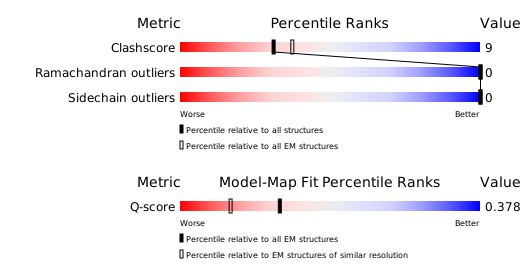
Structure validation
Download full validation report


