






 9QBS
9QBSSummary for 9QBS
| Entry DOI | 10.2210/pdb9qbs/pdb |
| Related | 9IH9 |
| Descriptor | Kelch-like ECH-associated protein 1, Cyclic peptide, GLYCEROL, ... (5 entities in total) |
| Functional Keywords | cyclic peptide, protein-protein interaction, structural protein |
| Biological source | Homo sapiens (human) More |
| Total number of polymer chains | 4 |
| Total formula weight | 65571.61 |
| Authors | |
| Primary citation | Ji, X.,Farrera-Soler, L.,Li, J.,Sangouard, G.,De Sadeleer, N.,Nielsen, A.L.,Mothukuri, G.K.,Zarda, A.,Will, E.J.,Pojer, F.,Lau, K.,Heinis, C. Generation of membrane-permeable cyclic peptides inhibiting protein-protein interaction. Nat.Chem.Biol., 22:1351-1361, 2026 Cited by PubMed Abstract: Small, nonpolar cyclic peptides can both bind challenging targets and cross cell membranes, making them attractive for addressing currently undruggable targets such as many protein-protein interactions (PPIs). However, developing such compounds de novo without prior information about lead structures such as natural ligands or fragments remains a notable challenge. Here we show that functional screening of structurally highly diverse cyclic peptide libraries synthesized at nanomole scale allows identification of sub-kDa inhibitors of a PPI. By screening 15,360 fully random cyclic peptides, we were able to identify an inhibitor of the E3 ligase adaptor Keap1 and its substrate Nrf2. Optimization by rapid design-build-test cycles produced a membrane-permeable compound active in live cells. This study demonstrates that large, diverse cyclic peptide libraries can enable the discovery of cell-permeable PPI inhibitors from the ground up, providing a way to harness the powerful modality of small cyclic peptides to address often difficult-to-target intracellular interactions. PubMed: 42225940DOI: 10.1038/s41589-026-02237-7 PDB entries with the same primary citation |
| Experimental method | X-RAY DIFFRACTION (1.95 Å) |
Structure validation
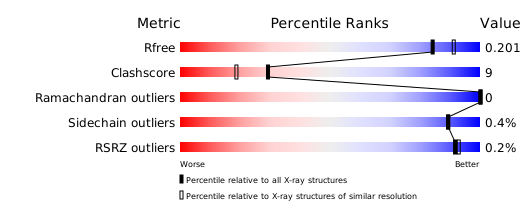
Download full validation report


