






 9QBA
9QBASummary for 9QBA
| Entry DOI | 10.2210/pdb9qba/pdb |
| Descriptor | E3 ubiquitin-protein ligase TRIM21, ~{N}-(cyclohexylmethyl)-4-(4-fluoranyl-2-methylsulfanyl-phenyl)-2-methylsulfonyl-benzamide, 1,2-ETHANEDIOL, ... (4 entities in total) |
| Functional Keywords | trim21, pryspry domain, e3 ligase, inhibitor, ligase |
| Biological source | Homo sapiens (human) |
| Total number of polymer chains | 1 |
| Total formula weight | 20892.57 |
| Authors | Kim, Y.,Lucic, A.,Knapp, S.,Kraemer, A.,Structural Genomics Consortium (SGC) (deposition date: 2025-03-01, release date: 2025-03-12, Last modification date: 2025-09-24) |
| Primary citation | Kim, Y.,Lucic, A.,Lenz, C.,Farges, F.,Schwalm, M.P.,Saxena, K.,Hanke, T.,Marples, P.G.,Aschenbrenner, J.C.,Fearon, D.,von Delft, F.,Kramer, A.,Knapp, S. Crystallographic fragment screening reveals ligand hotspots in TRIM21 PRY-SPRY domain. Commun Chem, 8:185-185, 2025 Cited by PubMed Abstract: Tripartite motif-containing protein 21 (TRIM21), and particularly its PRY-SPRY protein interaction domain, plays a critical role in the immune response by recognizing intracellular antibodies targeting them for degradation. In this study, we performed a crystallographic fragment screening (CFS) campaign to identify potential small molecule binders targeting the PRY-SPRY domain of TRIM21. Our screen identified a total of 109 fragments binding to TRIM21 that were distributed across five distinct binding sites. These fragments have been designed to facilitate straightforward follow-up chemistry, making them ideal starting points for further chemical optimization. A subsequent fragment merging approach demonstrated improved activity. To enable functional validation of compounds with full length human TRIM21, we established a NanoBRET assay suitable for measuring target engagement to the main Fc binding site in life cells. The high-resolution structural data and observed binding modes across the different sites highlight the versatility of the PRY-SPRY domain as a target for small-molecule intervention. The presented data provide a solid foundation for structure-guided ligand design, enabling the rational design of more potent and selective compounds, with the goal to develop bivalent molecules such as Proteolysis Targeting Chimeras (PROTACs). PubMed: 40514378DOI: 10.1038/s42004-025-01574-3 PDB entries with the same primary citation |
| Experimental method | X-RAY DIFFRACTION (1.45 Å) |
Structure validation
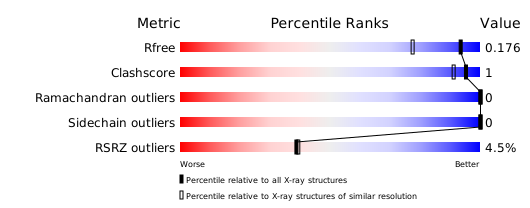
Download full validation report


