






 9Q1D
9Q1D
MS2 bacteriophage coat protein with waters modeled
Summary for 9Q1D
| Entry DOI | 10.2210/pdb9q1d/pdb |
| Related | 9Q1B |
| EMDB information | 72122 72124 |
| Descriptor | Capsid protein (2 entities in total) |
| Functional Keywords | bacteriophage, vlp, ms2, virus |
| Biological source | Escherichia phage MS2 |
| Total number of polymer chains | 3 |
| Total formula weight | 41215.39 |
| Authors | Zimanyi, C.M.,Bobe, D.,Jenkins, M.C.,Kopylov, M. (deposition date: 2025-08-13, release date: 2025-08-27, Last modification date: 2026-09-16) |
| Primary citation | Jenkins, M.C.,Bobe, D.,Johnston, J.D.,Cheung, J.,Karasawa, A.,Zimanyi, C.M.,Dermanci, O.,McManus, C.T.,Finn, M.G.,de Marco, A.,Kopylov, M. Overcoming air-water interface-induced artifacts in cryo-EM with protein nanocrates. Nat.Methods, 23:1798-1804, 2026 Cited by PubMed Abstract: Contact with the air-water interface can bias the orientation of macromolecules during cryo-electron microscopy sample preparation, leading to uneven sample distribution, preferred orientation and damage to the molecules of interest. To prevent this, we describe a method to encapsulate target proteins within highly hydrophilic, structurally homogeneous and stable protein shells, which we refer to as 'nanocrates' for this purpose. Here we describe the packaging, data acquisition and reconstruction of three proof-of-principle examples, each illuminating a different aspect of the method: apoferritin (demonstrating high-resolution), thyroglobulin (solving a known preferred orientation problem) and 7,8-dihydroneopterin aldolase (a structure previously uncharacterized by cryo-electron microscopy). PubMed: 42637978DOI: 10.1038/s41592-026-03184-w PDB entries with the same primary citation |
| Experimental method | ELECTRON MICROSCOPY (1.75 Å) |
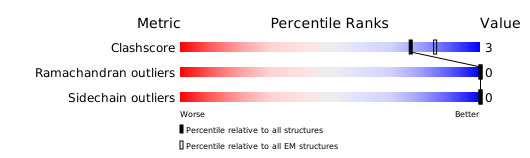
Structure validation
Download full validation report


