






 9PTM
9PTM
Antibody fragment from mAb824 bound to the adhesin protein FimH.
Summary for 9PTM
| Entry DOI | 10.2210/pdb9ptm/pdb |
| Related | 9ME6 9ME7 |
| EMDB information | 48185 48186 71842 |
| Descriptor | Type 1 fimbrin D-mannose specific adhesin, Protein FimG, mAb824 Heavy Chain, ... (4 entities in total) |
| Functional Keywords | fimbrial tip, lectin domain, antibody fragments, antibody-target complex, cell adhesion, cell adhesion-immune system complex, cell adhesion/immune system |
| Biological source | Escherichia coli More |
| Total number of polymer chains | 4 |
| Total formula weight | 93101.34 |
| Authors | Hvorecny, K.L.,Magala, P.,Klevit, R.E.,Kollman, J.M. (deposition date: 2025-07-29, release date: 2025-11-26, Last modification date: 2025-12-10) |
| Primary citation | Hvorecny, K.L.,Interlandi, G.,Veth, T.S.,Aprikian, P.,Manchenko, A.,Tchesnokova, V.L.,Dickinson, M.S.,Quispe, J.D.,Riley, N.M.,Klevit, R.E.,Magala, P.,Sokurenko, E.V.,Kollman, J.M. Antibodies disrupt bacterial adhesion by ligand mimicry and allosteric interference. Nat Commun, 16:10590-10590, 2025 Cited by PubMed Abstract: A critical step in infections is the attachment of microorganisms to host cells using lectins that bind glycans, making lectins promising antimicrobial targets. Upon binding mannosylated glycans, FimH, an adhesin in E. coli, undergoes an allosteric transition from an inactive to an active conformation that can act as a catch-bond. Distinct monoclonal antibodies that alter FimH glycan binding are available, but the mechanisms of action remain unclear. Here, we use cryo-electron microscopy, mass spectrometry, adhesion assays, and molecular dynamics simulations to determine the structure-function relationships underlying antibody-FimH binding. Our study demonstrates four mechanisms of action: ligand mimicry by an N-linked, high-mannose glycan; stabilization of the ligand pocket in the inactive state; conformational trapping of the active and inactive states; and locking of the ligand pocket through long-range allosteric effects. These structures reveal multiple mechanisms of antibody responses to an allosteric protein and provide blueprints for antimicrobials that target adhesins. PubMed: 41298446DOI: 10.1038/s41467-025-65666-3 PDB entries with the same primary citation |
| Experimental method | ELECTRON MICROSCOPY (3.4 Å) |
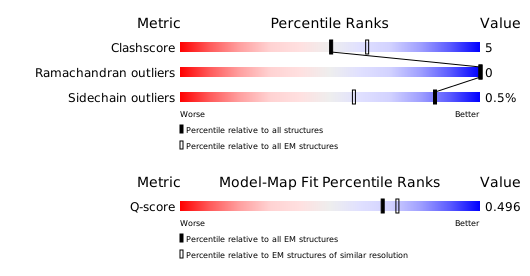
Structure validation
Download full validation report


