






 9PR3
9PR3
Cryo-EM structure of stabilized H5N1 A/Texas/37/2024 hemagglutinin fused to foldon
Summary for 9PR3
| Entry DOI | 10.2210/pdb9pr3/pdb |
| EMDB information | 71796 |
| Descriptor | Hemagglutinin, foldon fusion, 2-acetamido-2-deoxy-beta-D-glucopyranose (2 entities in total) |
| Functional Keywords | hpai h5n1, influenza hemagglutinin, stabilization, viral protein |
| Biological source | Influenza A virus |
| Total number of polymer chains | 3 |
| Total formula weight | 192608.58 |
| Authors | |
| Primary citation | Dosey, A.,Dadonaite, B.,Gillespie, R.A.,Leaf, E.M.,Vukovich, M.J.,McGowan, J.,Grey, E.,Muramatsu, H.,Jun, R.H.J.,Pardi, N.,Kanekiyo, M.,Bloom, J.D.,King, N.P. Stabilization of the H5 clade 2.3.4.4b hemagglutinin improves vaccine-elicited neutralizing antibody responses in mice. Sci Transl Med, 18:eaea8770-eaea8770, 2026 Cited by PubMed Abstract: Transmission of highly pathogenic avian influenza from H5 clade 2.3.4.4b has expanded in recent years to infect large populations of birds and mammals, heightening the risk of a human pandemic. Influenza viruses that are adapted to transmission in birds and a variety of mammals tend to have a less stable hemagglutinin (HA) than seasonal influenza viruses, enabling membrane fusion at comparatively higher pH levels. Here, we combined five mutations in the H5 HA that increased its melting temperature and promoted stable closure of the HA trimer. Structural analysis by cryo-electron microscopy revealed that the stabilizing mutations create several new hydrophobic interactions while maintaining the local HA structure. We found that vaccinating mice with stabilized H5 HA immunogens resulted in higher hemagglutination inhibition and neutralization titers than nonstabilized comparators. Epitope mapping of vaccine-elicited polyclonal antibody responses using negative-stain electron microscopy and deep mutational scanning showed that site E on the side of the HA receptor binding domain was immunodominant across all groups; however, the stabilized immunogens shifted responses toward the receptor binding site, which elicited a higher proportion of neutralizing antibodies. Consistent with these findings, stabilized H5 HA immunogens delivered as messenger RNA-lipid nanoparticle (mRNA-LNP) vaccines protected mice against H5N1 challenge. These findings highlight that H5 HA-stabilizing mutations enhance the quality of antibody responses across different vaccine formats, underscoring their potential to improve pandemic preparedness vaccines targeting viruses from this widely circulating clade. PubMed: 41779867DOI: 10.1126/scitranslmed.aea8770 PDB entries with the same primary citation |
| Experimental method | ELECTRON MICROSCOPY (3.2 Å) |
Structure validation
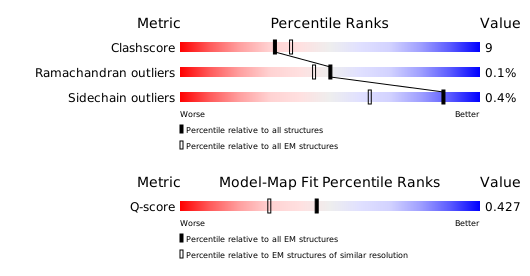
Download full validation report


