






 9PPP
9PPP
Structure of Alpha Appendage of AP2 bound to the extended FxDxF motif derived of CCDC32
Summary for 9PPP
| Entry DOI | 10.2210/pdb9ppp/pdb |
| Descriptor | AP-2 complex subunit alpha-2, Coiled-coil domain-containing protein 32, PENTAETHYLENE GLYCOL, ... (4 entities in total) |
| Functional Keywords | clathin, ap-2 adaptor complex, assembly chaperone, endocytosis |
| Biological source | Mus musculus (house mouse) More |
| Total number of polymer chains | 4 |
| Total formula weight | 61651.86 |
| Authors | Sloan, D.E.,Matthews, A.E.,Tedamrongwanish, T.,Nicely, N.I.,Baker, R.W. (deposition date: 2025-07-21, release date: 2026-04-08, Last modification date: 2026-04-15) |
| Primary citation | Sloan, D.E.,Matthews, A.,Yanagisawa, H.,Tedamrongwanish, T.,Cannon, K.,Simmons, J.,Chappell, G.,Nicely, N.I.,Berlow, R.,Kikkawa, M.,Baker, R.W. CCDC32 collaborates with the membrane to assemble the AP-2 clathrin adaptor complex. Biorxiv, 2025 Cited by PubMed Abstract: Cells have evolved a variety of assembly chaperones to aid in the difficult process of forming macromolecular complexes in a crowded cytoplasm. Assembly of adaptor protein complex 2 (AP-2), the primary cargo adaptor in clathrin-mediated endocytosis, is regulated by the chaperones AAGAB and CCDC32, whose deletion causes loss of all AP-2 subunits . AAGAB and CCDC32 are thought to act sequentially to assemble the AP-2 tetramer from its constituent heterodimers. However, the molecular requirements and structural consequences of CCDC32 interaction with AP-2 are not yet understood. Here, using reconstitution and integrative structural analysis, we describe the molecular mechanism of CCDC32-mediated AP-2 assembly. First, CCDC32 interacts with the appendage domain of the AP-2 α subunit, using the same binding site as canonical endocytic regulators in addition to a novel, yet highly conserved pocket on α. CCDC32 contains cargo sorting motifs normally found in trans-membrane cargo and binds to AP-2 heterodimers using canonical cargo-binding sites. Additionally, two amphipathic helices in CCDC32 bind to the α/σ2 heterodimer. Surprisingly, in solution, we find that CCDC32 prevents complex assembly and actively disassembles AP-2 tetramers. Inhibition requires the amphipathic helices of CCDC32, which also mediate binding to PIP2-containing membranes. The presence of PIP2-containing membrane stabilizes the final stages of assembly. We propose that the membrane acts as a molecular switch to release inhibitory interactions, allowing for full complex assembly to proceed. Using cryo-EM, we visualize an assembly intermediate that mimics the conformation of AP-2 found in vesicles, with CCDC32 bound at both cargo binding sites and both membrane-binding sites, suggesting that assembly leads to deposition of active complexes on the plasma membrane. PubMed: 40799577DOI: 10.1101/2025.08.05.668722 PDB entries with the same primary citation |
| Experimental method | X-RAY DIFFRACTION (2.1 Å) |
Structure validation
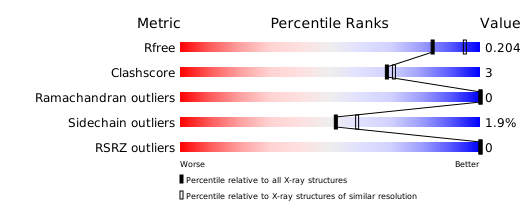
Download full validation report


