






 9PND
9PND
In situ microtubule of EpoB-induced regenerating axons
Summary for 9PND
| Entry DOI | 10.2210/pdb9pnd/pdb |
| EMDB information | 71750 71751 71752 71753 71754 71755 |
| Descriptor | Tubulin beta-3 chain, Detyrosinated tubulin alpha-1A chain, MAGNESIUM ION, ... (7 entities in total) |
| Functional Keywords | cytoskeleton, microtubules, neuroregeneration, axon, structural protein |
| Biological source | Mus musculus (house mouse) More |
| Total number of polymer chains | 4 |
| Total formula weight | 204357.21 |
| Authors | Bodakuntla, S.,Taira, K.,Yamada, Y.,Alvarez-Brecht, P.,Cada, A.K.,Basnet, N.,Zhang, R.,Martinez-Sanchez, A.,Biertumpfel, C.,Mizuno, N. (deposition date: 2025-07-20, release date: 2025-11-12, Last modification date: 2025-12-17) |
| Primary citation | Bodakuntla, S.,Taira, K.,Yamada, Y.,Alvarez-Brecht, P.,Cada, A.K.,Basnet, N.,Zhang, R.,Martinez-Sanchez, A.,Biertumpfel, C.,Mizuno, N. In situ structural mechanism of epothilone-B-induced CNS axon regeneration. Nature, 648:477-487, 2025 Cited by PubMed Abstract: Axons in the adult central nervous system (CNS) do not regenerate following injury, in contrast to neurons in the peripheral nervous system and neuronal growth during embryonic development. The molecular mechanisms that prevent regeneration of neurons in the CNS remain largely unknown. Here, to address the intracellular response to injury, we developed an in situ cryo-electron tomography and cryo-electron microscopy platform to mimic axonal damage and present the structural mechanism underlying thalamic axon regeneration induced by the drug epothilone B. We observed that stabilized microtubules extend beyond the injury site, generating membrane tension and driving membrane expansion. Cryo-electron microscopy reveals the in situ structure of microtubules at 3.19 Å resolution, which engage epothilone B within the microtubule lattice at the regenerating front. During repair, tubulin clusters are delivered and incorporated into polymerizing microtubules at the regenerating site. These microtubule shoots serve as scaffolds for various types of vesicles and endoplasmic reticulum, facilitating the supply of materials necessary for axon repair until membrane tension normalizes. We demonstrate the unexpected ability of neuronal cells to adjust to strain induced by epothilone B, which creates homeostatic imbalances and activates axons to regeneration mode. PubMed: 41224993DOI: 10.1038/s41586-025-09654-z PDB entries with the same primary citation |
| Experimental method | ELECTRON MICROSCOPY (3.19 Å) |
Structure validation
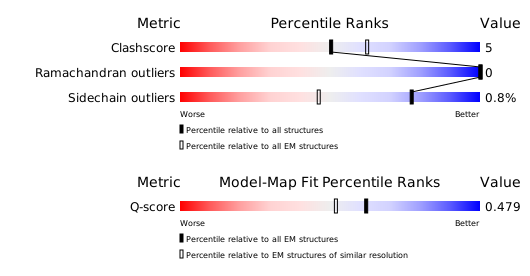
Download full validation report


