






 9PAV
Antibody (1B2) Bound Rifamycin Synthetase Module 1 in the Elongation Mode
This is a non-PDB format compatible entry.
Summary for 9PAV
| Entry DOI | 10.2210/pdb9pav/pdb |
| EMDB information | 71446 |
| Descriptor | Antibody Fragment 1B2 Heavy Chain, Antibody Fragment 1B2 Light Chain, 6-deoxyerythronolide-B synthase, ... (4 entities in total) |
| Functional Keywords | polyketide synthase module, antibody (fab), transferase-immune system complex, transferase/immune system |
| Biological source | Homo sapiens More |
| Total number of polymer chains | 7 |
| Total formula weight | 630746.75 |
| Authors | Cogan, D.P.,Liu, C.,West, R.C.,Chen, M. (deposition date: 2025-06-25, release date: 2025-07-23, Last modification date: 2026-09-30) |
| Primary citation | Liu, C.,West, R.C.,Chen, M.,Cohn, W.,Wang, G.,Kim, S.,Mandot, A.M.,Faull, K.F.,Cogan, D.P. C-terminal dimerization motifs control asynchronous chain elongation during modular polyketide biosynthesis. J.Biol.Chem., 302:113119-113119, 2026 Cited by PubMed Abstract: The rifamycin synthetase (RIFS) from the bacterium Amycolatopsis mediterranei is a homodimeric assembly line that catalyzes 40+ chemical reactions to generate a complex precursor of the antitubercular drug rifampicin. It consists of an N-terminal substrate loading module followed by a decamodular polyketide synthase (PKS). While the catalytic functions are known for each domain of RIFS, how these activities are spatially and temporally coordinated during polyketide assembly remains incompletely defined. Here, we address this problem with thiol-selective crosslinking to understand the basis for conformational asymmetry during polyketide chain elongation. Our data suggest that C-terminal dimerization motifs-which are ubiquitous in bacterial PKS assembly lines-force their adjacent substrate carrier protein (CP) domains to comigrate between two equivalent ketosynthase (KS) active site chambers. Cryogenic electron microscopy analysis of the first PKS module of RIFS further underscored this observation while revealing its unique architecture. Single-turnover kinetic analysis indicated that although changes to the C-terminus that reduced CP dimerization supported 2-fold greater KS:CP interactions, they were insufficient to overcome substoichiometric product accumulation on the homodimeric protein. Our findings illuminate factors underlying asymmetry during polyketide antibiotic biosynthesis and should be instructive to future megasynth(et)ase engineers. PubMed: 42103224DOI: 10.1016/j.jbc.2026.113119 PDB entries with the same primary citation |
| Experimental method | ELECTRON MICROSCOPY (3.22 Å) |
Structure validation
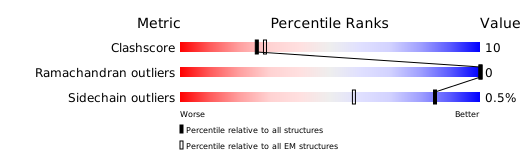
Download full validation report


