






 9P6F
9P6F
Structure of the SARS-CoV-2 main protease in complex with inhibitor SR-B-78
This is a non-PDB format compatible entry.
Summary for 9P6F
| Entry DOI | 10.2210/pdb9p6f/pdb |
| Descriptor | 3C-like proteinase nsp5, (1R,2S,5S)-N-[(1S,2Z)-2-imino-1-(5-methoxypyridin-3-yl)ethyl]-6,6-dimethyl-3-[3-methyl-N-(trifluoroacetyl)-L-valyl]-3-azabicyclo[3.1.0]hexane-2-carboxamide (2 entities in total) |
| Functional Keywords | hydrolase, viral protein |
| Biological source | Severe acute respiratory syndrome coronavirus 2 |
| Total number of polymer chains | 1 |
| Total formula weight | 34337.08 |
| Authors | Blankenship, L.R.,Liu, W.R. (deposition date: 2025-06-18, release date: 2026-03-04, Last modification date: 2026-04-08) |
| Primary citation | Khatua, K.,Atla, S.,Coleman, D.,Blankenship, L.R.,Alugubelli, Y.R.,Vulupala, V.,Guo, X.S.,Xia, H.,Kalveram, B.K.,Walker, D.H.,Hurst, B.L.,Kumar, S.,Cho, C.D.,Sharma, S.,Yang, K.,Rabie, D.,Nyalata, S.,Neuman, B.W.,Xie, X.,Xu, S.,Liu, W.R. From nicotine to SARS-CoV-2 antivirals with potent in vivo efficacy and a broad anti-coronavirus spectrum. Nat Commun, 17:-, 2026 Cited by PubMed Abstract: Anecdotal reports about smoking that might prevent SARS-CoV-2 infection inspire the search for nicotine and its pyrolysis products as inhibitors of the SARS-CoV-2 main protease (M). This effort leads to the discovery of 3-vinylpyridine as an M inhibitor. 3-Vinylpyridine resembles part of nirmatrelvir in binding to M but does not involve a critical interaction with residue E166, whose mutation has led to resistance to nirmatrelvir. Integration of the two molecules, followed by a medicinal chemistry campaign, produces several molecules with better in vitro potency than nirmatrelvir. Two lead molecules, YR-C-136 and SR-B-103, display better pharmacokinetic characteristics than nirmatrelvir in virus-challenged male mice and much better antiviral efficacy in virus-challenged female mice. Both molecules maintain high potency in inhibiting the nirmatrelvir-resistant M (E166V/L50F) variant. They also exhibit a broad and highly potent antiviral spectrum against most pathogenic coronaviruses. With high in vivo potency, both molecules are potentially standalone pan-antivirals for coronaviruses and may serve as countermeasures for future coronavirus outbreaks. PubMed: 41690944DOI: 10.1038/s41467-026-69527-5 PDB entries with the same primary citation |
| Experimental method | X-RAY DIFFRACTION (1.8 Å) |
Structure validation
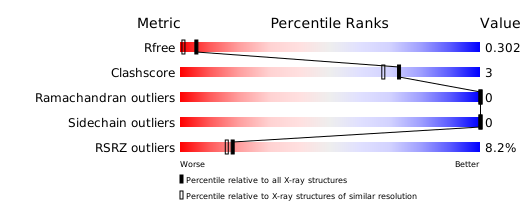
Download full validation report


