






 9OUF
9OUF
Crystal structure of an ADP-ribosyl hydrolase from Streptococcus parasanguinis
Summary for 9OUF
| Entry DOI | 10.2210/pdb9ouf/pdb |
| Descriptor | Ribonuclease, 1,2-ETHANEDIOL, CHLORIDE ION, ... (4 entities in total) |
| Functional Keywords | adp-ribosyl cyclase/hydrolase, toxin, antibacterial, hydrolase |
| Biological source | Streptococcus parasanguinis |
| Total number of polymer chains | 1 |
| Total formula weight | 17971.19 |
| Authors | |
| Primary citation | Colautti, J.,Kim, Y.,Whitney, J.C. Antibacterial ADP-ribosyl cyclase toxins inhibit bacterial growth by rapidly depleting NAD(P). J.Biol.Chem., :110491-110491, 2025 Cited by PubMed Abstract: In metazoans, enzymes belonging to the bifunctional ADP-ribosyl cyclase/cyclic ADP-ribose (cADPr) hydrolase family regulate diverse cellular processes by synthesizing and hydrolyzing the intracellular second messenger cADPr, derived from the electron carrier NAD. However, bacterial enzymes belonging to this family have not been characterized. Here, we identify a bacterial ADP-ribosyl cyclase that is associated with the type VII secretion system and functions as an antibacterial toxin. This enzyme, which we name Tac1, inhibits bacterial growth by rapidly hydrolyzing NAD and NADP. We determine the X-ray crystal structure of Tac1 to a resolution of 1.4 Å, which reveals that this protein adopts the core catalytic fold of metazoan ADP-ribosyl cyclase enzymes such as CD38. Using a combination of biochemical and mutagenesis approaches, we identify catalytic residues within the active site of Tac1, which are responsible for the formation of a cADPr catalytic intermediate and subsequent hydrolysis of this intermediate into linear ADP-ribose. A bioinformatic analysis reveals that Tac1 is the founding member of a widespread family of bacterial ADP-ribosyl cyclase enzymes, many of which are associated with interbacterial conflict systems. We also identify enzymes in this family that are not associated with biological conflict systems and demonstrate that they produce cADPr as their major product rather than linear ADP-ribose, suggesting that these enzymes serve a biological function distinct from interbacterial antagonism. Together, these findings demonstrate that ADP-ribosyl cyclase/cADPr hydrolase enzymes function as toxins in diverse bacterial conflict systems and suggest that cADPr may play a previously overlooked role in bacterial physiology. PubMed: 40680842DOI: 10.1016/j.jbc.2025.110491 PDB entries with the same primary citation |
| Experimental method | X-RAY DIFFRACTION (1.39 Å) |
Structure validation
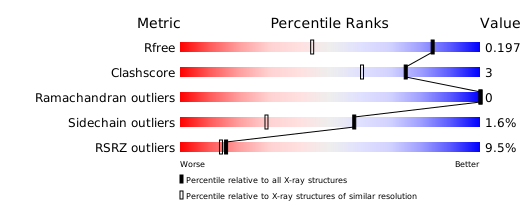
Download full validation report


