






 9OQL
9OQL
Putative ATP-bound class from combined 10, 20, 30 mM ATP datasets
Summary for 9OQL
| Entry DOI | 10.2210/pdb9oql/pdb |
| EMDB information | 70765 |
| Descriptor | Pannexin-1, PHOSPHATIDYLETHANOLAMINE, CHOLESTEROL, ... (5 entities in total) |
| Functional Keywords | pannexin 1, atp release, large-pore ion channel, membrane protein, transport protein |
| Biological source | Homo sapiens (human) |
| Total number of polymer chains | 7 |
| Total formula weight | 349264.11 |
| Authors | |
| Primary citation | Li, Y.,Ruan, Z.,Lee, J.,Orozco, I.J.,Zhou, E.,Du, J.,Lu, W. Structural basis of PANX1 permeation and positive modulation by mefloquine. Nat Commun, 16:11057-11057, 2025 Cited by PubMed Abstract: Purinergic signaling relies on ATP release through exocytosis and large-pore channels. Large-pore channels permeate both small anions like chloride and large signaling molecules like ATP, but how this broad cargo selectivity is structurally controlled remains elusive. Here we investigate PANX1, a prototypical large-pore channel, and uncover structural plasticity at the extracellular entrance formed by seven tryptophan (W74) residues. The W74 sidechains are flexible, sampling conformations that range from a constricted state permissive only to chloride to a dilated state compatible with ATP. These states are coupled to variable cation-π interactions between W74 and arginine 75 (R75), suggesting a mechanism for dynamic tuning of pore architecture and selective cargo permeation. We also identify mefloquine as a positive modulator of PANX1 that binds near the side tunnel to control ion flow through this pathway. Together, these findings define the structural principles underlying PANX1 permeation and modulation. PubMed: 41381453DOI: 10.1038/s41467-025-66028-9 PDB entries with the same primary citation |
| Experimental method | ELECTRON MICROSCOPY (2.77 Å) |
Structure validation
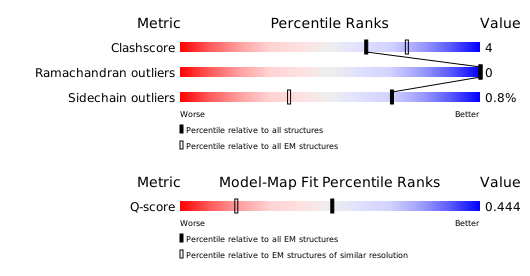
Download full validation report


