






 9OP0
9OP0
Mycobacterium tuberculosis adenylosuccinate lyase
Summary for 9OP0
| Entry DOI | 10.2210/pdb9op0/pdb |
| Related | 9OO0 |
| Descriptor | Adenylosuccinate lyase, GLYCEROL (3 entities in total) |
| Functional Keywords | adenylosuccinate lyase apo form, lyase |
| Biological source | Mycobacterium tuberculosis |
| Total number of polymer chains | 2 |
| Total formula weight | 104166.81 |
| Authors | |
| Primary citation | Singh, V.,Jaganathan, D.,Corro, J.,Chen, K.,Kumar Samrat, S.,Zhang, R.,Ma, M.,Battaile, K.P.,Li, Z.,Zhang, Q.Y.,Xiong, R.,Ojha, A.K.,Li, H. Structure, Function, and Inhibition of Adenylosuccinate Lyase (ADSL) from Mycobacterium tuberculosis . Acs Infect Dis., 12:74-90, 2026 Cited by PubMed Abstract: (ADSL), encoded by the gene, is an essential enzyme in the purine biosynthesis pathway of (), making it a promising target for antimicrobial drug development. Here, we report the expression, purification, kinetic characterization, high-throughput screening (HTS), and structural analysis of ADSL. We developed a highly sensitive and scalable bioluminescent assay using a PPDK-luciferase coupling system to quantify ADSL enzymatic activity AMP detection. This assay enabled reliable kinetic analysis and successful pilot HTS of a small-molecule library, identifying bithionol and tetraiodothyroacetic acid (Tetrac) as inhibitors of ADSL. Inhibitory activity was confirmed using an orthogonal fluorescence polarization (FP) assay and further validated using the AMP-Glo luminescence assay. Specificity was evaluated using human ADSL (ADSL) to confirm that the compounds selectively inhibited ADSL while sparing the human enzyme. Thermal shift and gel-based protein stability assays demonstrated direct binding of bithionol and Tetrac to ADSL. Furthermore, bithionol and Tetrac displayed antibacterial activity against strains H37Ra and H37Rv, with moderate to low cytotoxicity toward human cells. Supplementation with exogenous AMP restored the growth of H37Ra inhibited by bithionol and Tetrac, confirming that both compounds act through on-target engagement of ADSL. The phagocytosis assay demonstrated that the compounds retained intracellular efficacy against . Finally, we determined the crystal structures of ADSL in two apo forms at high resolution (1.78 Å and 2.1 Å), revealing conserved tetrameric architecture with distinct active-site features that differentiate from human ADSL. Modeling suggested that both compounds bind to an allosteric site adjacent to the active site. These findings provide a framework for structure-guided development of selective ADSL inhibitors as potential antitubercular agents. PubMed: 41358587DOI: 10.1021/acsinfecdis.5c00442 PDB entries with the same primary citation |
| Experimental method | X-RAY DIFFRACTION (1.78 Å) |
Structure validation
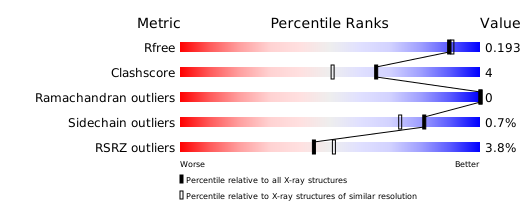
Download full validation report


