






 9OGE
9OGE
Cryo-EM structure of human exportin-1 conjugated with KPT-127 and bound to human ASB8-ELOB/C
This is a non-PDB format compatible entry.
Summary for 9OGE
| Entry DOI | 10.2210/pdb9oge/pdb |
| EMDB information | 70463 |
| Descriptor | Exportin-1, Ankyrin repeat and SOCS box protein 8, Elongin-C, ... (5 entities in total) |
| Functional Keywords | nuclear export, inhibitor, protein degradation, protein transport |
| Biological source | Homo sapiens (human) More |
| Total number of polymer chains | 4 |
| Total formula weight | 177947.79 |
| Authors | Wing, C.E.,Fung, H.Y.J.,Chook, Y.M. (deposition date: 2025-04-30, release date: 2025-11-26, Last modification date: 2026-07-22) |
| Primary citation | Wing, C.E.,Fung, H.Y.J.,Kwanten, B.,Cagatay, T.,Niesman, A.B.,Jacquemyn, M.,Gharghabi, M.,Permentier, B.,Shakya, B.,Nandi, R.,Ready, J.M.,Kashyap, T.,Shacham, S.,Landesman, Y.,Lapalombella, R.,Daelemans, D.,Chook, Y.M. SINE compounds activate exportin 1 degradation through an allosteric mechanism. Nat.Chem.Biol., 21:2002-2013, 2025 Cited by PubMed Abstract: Overexpression of exportin 1 (XPO1/CRM1) in cancer cells mislocalizes numerous cancer-related nuclear export cargoes. Covalent selective inhibitors of nuclear export (SINEs), including the cancer drug selinexor, restore proper nuclear localization by blocking XPO1-cargo interaction. These inhibitors also induce XPO1 degradation through the Cullin-RING E3 ligase (CRL) substrate receptor ASB8. Here we present cryo-electron microscopy structures revealing ASB8 binding to a cryptic XPO1 site that is exposed upon SINE conjugation. Unlike typical molecular glue degraders that directly bridge CRLs and substrates, SINEs bind XPO1 independently of ASB8, triggering an allosteric mechanism that enables high-affinity ASB8 recruitment, leading to XPO1 ubiquitination and degradation. ASB8-mediated degradation is also triggered by the endogenous itaconate derivative 4-octyl itaconate, suggesting that synthetic XPO1 inhibitors exploit a native cellular mechanism. This allosteric XPO1 degradation mechanism expands known modes of targeted protein degradation beyond molecular glue degraders and proteolysis-targeting chimeras of CRL4. PubMed: 41286136DOI: 10.1038/s41589-025-02058-0 PDB entries with the same primary citation |
| Experimental method | ELECTRON MICROSCOPY (3.28 Å) |
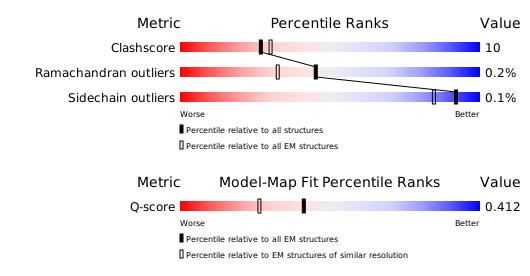
Structure validation
Download full validation report


