






 9OC3
9OC3
Transcription factor DeltaFOSB/JUND bZIP domain in complex with an effector molecule
This is a non-PDB format compatible entry.
Summary for 9OC3
| Entry DOI | 10.2210/pdb9oc3/pdb |
| Descriptor | Protein FosB, Transcription factor jun-D, (5M)-5-(3-amino-5-oxo-4,5-dihydro-1H-pyrazol-1-yl)-2-phenoxybenzene-1-sulfonic acid, ... (5 entities in total) |
| Functional Keywords | deltafosb, ap1 transcription factor, bzip domain, allosteric site, cut&run, in vivo compound administration, cell adhesion |
| Biological source | Homo sapiens (human) More |
| Total number of polymer chains | 2 |
| Total formula weight | 16899.78 |
| Authors | Machius, M.,Kumar, A.,Rudenko, G. (deposition date: 2025-04-23, release date: 2026-01-07, Last modification date: 2026-02-04) |
| Primary citation | McNeme, S.,Yim, Y.Y.,Kumar, A.,Li, Y.,Hughes, B.,St Romain, C.P.,Aglyamova, G.,Chen, J.,Nguyen, N.D.,Fan, S.,Stephens, G.S.,Zhao, W.N.,Kruzshak, S.,Estill, M.,Brener, C.,Tofani, S.,Kumar, A.,Chen, E.P.,Takatka, N.,Robison, A.J.,Chen, H.,Powell, R.T.,Haggarty, S.J.,Stephan, C.,Nestler, E.J.,Chin, J.,Machius, M.,Zhou, J.,Rudenko, G. Discovery of small molecules and a druggable groove that regulate DNA binding and release of the AP-1 transcription factor Delta FOSB. J.Biol.Chem., 302:111080-111080, 2025 Cited by PubMed Abstract: ΔFOSB, a member of the AP-1 family of transcription factors, mediates long-term neuroadaptations underlying drug addiction, seizure-related cognitive decline, dyskinesias, and several other chronic conditions. AP-1 transcription factors are notoriously difficult to modulate pharmacologically due to the absence of well-defined binding pockets. Here, we identify a novel site on ΔFOSB, located outside the DNA-binding cleft, that accommodates small molecules. We show that sulfonic acid-containing compounds bind to this site via an induced-fit mechanism, reorienting side chains critical for DNA binding, and that they may hinder the ΔFOSB bZIP α-helix from binding to the major groove of DNA. In vivo, direct administration of one such compound, JPC0661, into the brain reduces ΔFOSB occupancy at genomic AP-1 consensus sites by approximately 60% as determined by CUT&RUN-sequencing. These findings suggest that DNA binding and release by AP-1 transcription factors can be controlled via small molecules that dock into a novel site that falls outside of the DNA-binding cleft. Minimal sequence conservation across 29 bZIP domain-containing transcription factors in this druggable groove suggests that it can be exploited to develop AP-1-subunit-selective compounds. Our studies thus reveal a novel strategy to design small-molecule inhibitors of ΔFOSB and other members of the bZIP transcription factor family. PubMed: 41443415DOI: 10.1016/j.jbc.2025.111080 PDB entries with the same primary citation |
| Experimental method | X-RAY DIFFRACTION (1.73 Å) |
Structure validation
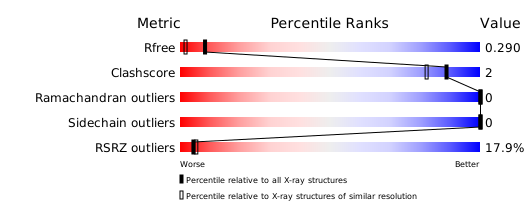
Download full validation report


