






 9O85
9O85
Cryo-EM structure of KCa2.2_I/calmodulin channel in complex with rimtuzalcap
This is a non-PDB format compatible entry.
Summary for 9O85
| Entry DOI | 10.2210/pdb9o85/pdb |
| EMDB information | 70217 |
| Descriptor | Small conductance calcium-activated potassium channel protein 2, Calmodulin-1, POTASSIUM ION, ... (6 entities in total) |
| Functional Keywords | ion channel, small-conductance calcium-activated potassium channel, membrane protein, transport protein |
| Biological source | Rattus norvegicus (Norway rat) More |
| Total number of polymer chains | 8 |
| Total formula weight | 240460.25 |
| Authors | |
| Primary citation | Nam, Y.W.,Ramanishka, A.,Xu, Y.,Yasuda, R.M.H.,Nasburg, J.A.,Im, D.,Cui, M.,Chandy, K.G.,Wulff, H.,Zhang, M. Structural basis for the subtype-selectivity of K Ca 2.2 channel activators. Nat Commun, 17:531-531, 2026 Cited by PubMed Abstract: Small-conductance (K2.2) and intermediate-conductance (K3.1) Ca-activated K channels are gated by a Ca-calmodulin dependent mechanism. NS309 potentiates the activity of both K2.2 and K3.1, while rimtuzalcap selectively activates K2.2. Rimtuzalcap has been used in clinical trials for the treatment of spinocerebellar ataxia and essential tremor. We report cryo-electron microscopy structures of NS309-bound K2.2 and K3.1, in addition to structures of rimtuzalcap-bound K2.2 and mutant K3.1_R355K. The different conformations of calmodulin and the cytoplasmic HC helices in the two channels underlie the subtype-selectivity of rimtuzalcap for K2.2. NS309 binds to pre-existing pockets in both channels, while the bulkier rimtuzalcap binds in an induced-fit pocket in K2.2 requiring conformational changes. In K2.2, calmodulin's N-lobes are sufficiently far apart to enable conformational changes to accommodate either NS309 or rimtuzalcap. In K3.1, calmodulin's N-lobes are closer to each other and constrained by K3.1's HC helices, which allows binding of NS309 but not rimtuzalcap. Replacement of arginine-355 in K3.1's HB helix with lysine (K3.1_R355K) allows the binding of rimtuzalcap and renders the mutant channel sensitive to rimtuzalcap. These structures provide a framework for structure-based drug design targeting K2.2 channels. PubMed: 41507196DOI: 10.1038/s41467-025-67232-3 PDB entries with the same primary citation |
| Experimental method | ELECTRON MICROSCOPY (3.13 Å) |
Structure validation
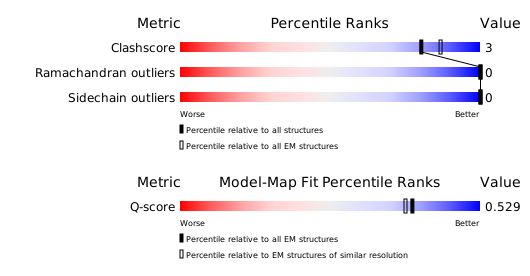
Download full validation report


