






 9O3Y
9O3Y
Human 80S ribosome bound to IDB-002 stalled on FPAK-containing nascent chain
This is a non-PDB format compatible entry.
Summary for 9O3Y
| Entry DOI | 10.2210/pdb9o3y/pdb |
| EMDB information | 70083 70084 70085 70086 |
| Descriptor | 28S rRNA, Large ribosomal subunit protein eL8, Large ribosomal subunit protein uL6, ... (90 entities in total) |
| Functional Keywords | translation inhibitor, interdictor, ribosome, cryogenic-electron microscopy (cryo-em), ribotoxic stress response, cancer, myc, translation |
| Biological source | Homo sapiens More |
| Total number of polymer chains | 82 |
| Total formula weight | 3834124.00 |
| Authors | Sauer, P.V.,Schuller, A.P.,Hamann, L.G. (deposition date: 2025-04-07, release date: 2026-03-04, Last modification date: 2026-07-01) |
| Primary citation | Diamond, P.D.,Sauer, P.V.,Holm, M.,Swanson-Swett, C.J.,Ferguson, L.,Bratset, N.M.,Wienker, G.W.,Sim, J.S.,Adams, H.K.,Kenner, L.,Meyers, M.,Gygi, D.,Konst, Z.A.,Bahmanyar, S.S.,Hamann, L.G.,Schuller, A.P. Context-dependent translation inhibition as a cancer therapeutic modality. Nat Commun, 17:-, 2026 Cited by PubMed Abstract: Recent work has demonstrated that some bacterial antibiotics that inhibit protein synthesis by binding the peptidyl transferase center (PTC) of the ribosome act in a context-dependent manner, inhibiting translation elongation only at specific amino acids. However, this phenomenon has yet to be documented for compounds that inhibit the PTC of the human ribosome. Here, we use structure-based design to guide the synthesis of such PTC-binding, context-dependent inhibitors of the human ribosome, termed interdictors. In the PTC, these compounds preferentially interact with nascent protein residues that exhibit complementary physiochemical properties to the moieties of the small molecule, causing structural rearrangements in both the nascent polypeptide chain and ribosomal RNA. Further, the compounds differentially impact ribosome surveillance pathways, including the ribotoxic stress response. Finally, we confirm their anti-tumor activity after oral dosing in a mouse xenograft model of triple-negative breast cancer. Together, our data establish targeting oncogenic dependency factors through context-dependent inhibition of translation as a potential small molecule therapeutic modality for historically difficult to address cancers. PubMed: 41735331DOI: 10.1038/s41467-026-69891-2 PDB entries with the same primary citation |
| Experimental method | ELECTRON MICROSCOPY (2.2 Å) |
Structure validation
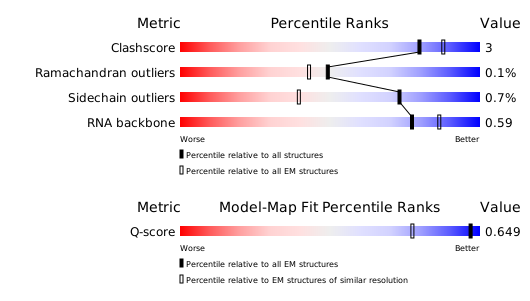
Download full validation report


