






 9NYY
9NYY
Nucleic acid bound human SLFN14, State 1
Summary for 9NYY
| Entry DOI | 10.2210/pdb9nyy/pdb |
| EMDB information | 49946 |
| Descriptor | Protein SLFN14, RNA (5'-R(P*AP*UP*GP*GP*G)-3'), RNA (5'-R(P*CP*CP*CP*AP*CP*UP*C)-3'), ... (5 entities in total) |
| Functional Keywords | nuclease, antiviral factor, post-transcriptional regulator, rna binding protein |
| Biological source | Homo sapiens (human) More |
| Total number of polymer chains | 4 |
| Total formula weight | 219262.82 |
| Authors | Van Riper, J.,Martinez-Claros, A.O.,Wang, L.,Schneiderman, H.,Maheshwari, S.,Pillon, M.C. (deposition date: 2025-03-29, release date: 2025-07-09, Last modification date: 2025-07-16) |
| Primary citation | Van Riper, J.,Martinez-Claros, A.O.,Wang, L.,Schneiderman, H.E.,Maheshwari, S.,Pillon, M.C. CryoEM structure of the SLFN14 endoribonuclease reveals insight into RNA binding and cleavage. Nat Commun, 16:5848-5848, 2025 Cited by PubMed Abstract: The SLFN14 endoribonuclease is a post-transcriptional regulator that targets the ribosome and its associated RNA substrates for codon-bias translational repression. SLFN14 nuclease activity is linked to antiviral defense and platelet function. Despite its prominent role in gene regulation, the molecular signals regulating SLFN14 substrate recognition and catalytic activation remain unclear. SLFN14 dysregulation is linked to human diseases, including ribosomopathies and inherited thrombocytopenia, thus underscoring the importance of establishing the signals coordinating its RNA processing activity. Here, we reconstitute active full-length human SLFN14 and report a high-resolution cryoEM reconstruction of the SLFN14•RNA complex. The structure reveals a medallion-like architecture that shares structural homology with other SLFN family members. We unveil a C-terminal hydrophobic intermolecular interface that stabilizes the SLFN14 homodimer without the need for additional molecular signals. We describe compact sequence-independent RNA binding interfaces and highlight the environment of the SLFN14 disease hotspot at the RNA cleft entrance. We show that the SLFN14 endoribonuclease has broad site-specificity in the absence of modified native tRNA, a characteristic not shared with its SLFN11 family member. Finally, we demonstrate that metal-dependent acceptor stem cleavage requires the SLFN14 E-EhK motif and uncover its unexpected parallel with other virus-activatable nucleases. PubMed: 40592880DOI: 10.1038/s41467-025-61091-8 PDB entries with the same primary citation |
| Experimental method | ELECTRON MICROSCOPY (2.73 Å) |
Structure validation
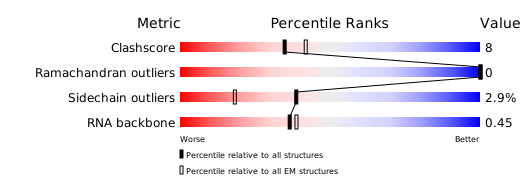
Download full validation report


