






 9NVM
9NVM
ATPase Hybrid F1 with the ancestral core domains Catalytic Dwell
Summary for 9NVM
| Entry DOI | 10.2210/pdb9nvm/pdb |
| EMDB information | 49840 |
| Descriptor | ATPase hybrid F1 with the ancestral core domains alpha chains, ATPase hybrid F1 with the ancestral core domains beta chains, ATP synthase gamma chain, ... (6 entities in total) |
| Functional Keywords | enerygy, ancestral atpase, electron transport |
| Biological source | Bacillus sp. PS3 More |
| Total number of polymer chains | 7 |
| Total formula weight | 363540.75 |
| Authors | Stewart, A.G.,Noji, H.,Sobti, M.,Suzuki, A.K. (deposition date: 2025-03-20, release date: 2025-11-05) |
| Primary citation | Suzuki, A.K.,Furukawa, R.,Sobti, M.,Brown, S.H.J.,Stewart, A.G.,Akanuma, S.,Ueno, H.,Noji, H. Functional and structural characterization of F 1 -ATPase with common ancestral core domains in stator ring. Protein Sci., 34:e70345-e70345, 2025 Cited by PubMed Abstract: Extant F-ATPases exhibit diverse rotational stepping behaviors-3-, 6-, or 9-step cycles-yet the evolutionary origin of these patterns remains unclear. Here, we used ancestral sequence reconstruction to infer the catalytic β and non-catalytic α subunits of a putative ancestral F-ATPase. We then fused their functionally critical domains into the thermostable F from Bacillus PS3, yielding a stable chimeric enzyme. Cryo-EM revealed two distinct conformational states-binding and catalytic dwell states-separated by a ~34° rotation of the γ subunit, suggesting a fundamental six-step mechanism akin to that of extant six-stepping F-ATPases. Single-molecule rotation assays with ATP and the slowly hydrolyzed ATP analog ATPγS demonstrated that the chimeric motor is intrinsically a six-stepper, pausing at binding and catalytic dwell positions separated by 32.1°, although the binding dwell is significantly prolonged by an unknown mechanism. These findings indicate that F-ATPase was originally a six-stepper and diversified into 3-, 6- and 9-step forms in evolutionary adaptation. Based on these results, we discuss plausible features of the entire FF complex, along with potential physiological contexts in the last universal common ancestor and related lineages. PubMed: 41131942DOI: 10.1002/pro.70345 PDB entries with the same primary citation |
| Experimental method | ELECTRON MICROSCOPY (2.58 Å) |
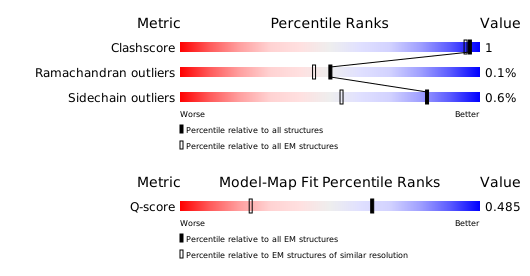
Structure validation
Download full validation report


