






 9NU1
9NU1
Uromodulin filament lattice interface from human urine
Summary for 9NU1
| Entry DOI | 10.2210/pdb9nu1/pdb |
| EMDB information | 49792 |
| Descriptor | Uromodulin, 2-acetamido-2-deoxy-beta-D-glucopyranose-(1-4)-2-acetamido-2-deoxy-beta-D-glucopyranose, alpha-D-mannopyranose-(1-3)-beta-D-mannopyranose-(1-4)-2-acetamido-2-deoxy-beta-D-glucopyranose-(1-4)-2-acetamido-2-deoxy-beta-D-glucopyranose, ... (4 entities in total) |
| Functional Keywords | kidney, urine, uropathogen, filament, lattice, antimicrobial protein, kidney disease, uti, urinary tract infection, infection, interface |
| Biological source | Homo sapiens (human) |
| Total number of polymer chains | 4 |
| Total formula weight | 282278.49 |
| Authors | Chang, A.N.,Fitzpatrick, A.W.P. (deposition date: 2025-03-19, release date: 2025-05-21, Last modification date: 2025-07-16) |
| Primary citation | Chang, A.N.,Cerutti, G.,Ogawa, Y.,Basler, A.,Switzer, W.,Eng-Kohn, M.,Lee, C.,Fitzpatrick, A.W.P. Structural basis of human uromodulin filament networks in uropathogen capture. Structure, 33:1186-1192.e3, 2025 Cited by PubMed Abstract: Uromodulin (UMOD), the most abundant protein in human urine, is essential for kidney function and urinary tract health. UMOD forms filaments that bind to uropathogenic bacteria, facilitating their aggregation and clearance from the urinary tract. Here, we present the cryo-electron microscopy (cryo-EM) structure of the bacteria-binding D10C domain of UMOD and reveal its binding to the filament core. The details of D10C-core binding explain the formation of distinct filament lattice architectures adopted by UMOD. The D10C-core binding interface gives rise to diverse filament lattice structures, ranging from open and expansive to compact and dense conformations, or a combination of both. We hypothesize that other molecules present in urine may act as cross-linking agents, further stabilizing this binding interface and facilitating the connection of individual filaments into larger networks capable of effectively trapping bacteria. Structural mapping of kidney disease-related mutations points toward the abolition of disulfide bonds and promotion of mutant UMOD aggregation. PubMed: 40345203DOI: 10.1016/j.str.2025.04.011 PDB entries with the same primary citation |
| Experimental method | ELECTRON MICROSCOPY (3.6 Å) |
Structure validation
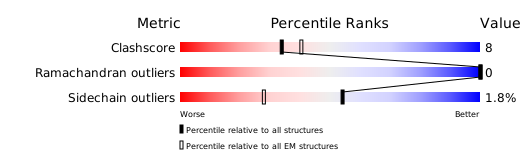
Download full validation report


