






 9NT0
9NT0
OXA-23-meropenem, pH 7.5
Summary for 9NT0
| Entry DOI | 10.2210/pdb9nt0/pdb |
| Descriptor | Beta-lactamase OXA-23, (4R,5S)-3-{[(3S,5S)-5-(dimethylcarbamoyl)pyrrolidin-3-yl]sulfanyl}-5-[(2S,3R)-3-hydroxy-1-oxobutan-2-yl]-4-methyl-4,5-d ihydro-1H-pyrrole-2-carboxylic acid, SULFATE ION, ... (4 entities in total) |
| Functional Keywords | oxa, antibiotic resistance, inhibitor, meropenem, hydrolase |
| Biological source | Acinetobacter baumannii |
| Total number of polymer chains | 1 |
| Total formula weight | 31536.34 |
| Authors | Smith, C.A.,Toth, M.,Stewart, N.K.,Vakulenko, S.B. (deposition date: 2025-03-17, release date: 2025-08-06, Last modification date: 2025-10-15) |
| Primary citation | Toth, M.,Stewart, N.K.,Quan, P.,Khan, M.M.K.,Cox, J.,Buynak, J.D.,Smith, C.A.,Vakulenko, S.B. Dual mechanism of the OXA-23 carbapenemase inhibition by the carbapenem NA-1-157. Antimicrob.Agents Chemother., 69:e0091825-e0091825, 2025 Cited by PubMed Abstract: Carbapenem-resistant continues to be a leading cause of life-threatening infections that result in high mortality rates. The major cause of carbapenem resistance in this pathogen is the production of class D carbapenemases, enzymes that inactivate the last resort carbapenem antibiotics, thus significantly diminishing the available therapeutic options. In this study, we evaluated the interaction of OXA-23, the most widely disseminated class D carbapenemase in clinical isolates, with the atypically modified carbapenem, NA-1-157. The MICs of this compound against strains producing OXA-23 were reduced from highly resistant levels observed for the commercial carbapenems meropenem and imipenem (16-128 µg/mL) to sensitive or intermediate levels (2-4 µg/mL). Kinetic studies showed that NA-1-157 inhibits the enzyme due to a significant decrease (>2,000-fold) in the deacylation rate relative to its closest structural analog, meropenem. Structural studies and molecular dynamics simulations demonstrated that inhibition is caused by both the inability of a water molecule to get close enough to the scissile bond to perform deacylation and by partial decarboxylation of the catalytic lysine residue upon formation of the acyl-enzyme intermediate. PubMed: 40833279DOI: 10.1128/aac.00918-25 PDB entries with the same primary citation |
| Experimental method | X-RAY DIFFRACTION (1.6 Å) |
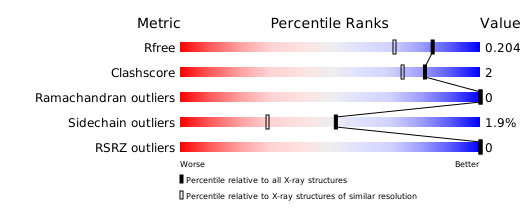
Structure validation
Download full validation report


