






 9NMO
9NMO
Structure of mouse RyR1 (Ca2+/CFF/ATP dataset; closed pore)
This is a non-PDB format compatible entry.
Summary for 9NMO
| Entry DOI | 10.2210/pdb9nmo/pdb |
| EMDB information | 49535 |
| Descriptor | Ryanodine receptor 1, Peptidyl-prolyl cis-trans isomerase FKBP1A, ZINC ION, ... (7 entities in total) |
| Functional Keywords | calcium, ion channel, transport protein |
| Biological source | Mus musculus (house mouse) More |
| Total number of polymer chains | 8 |
| Total formula weight | 2322081.89 |
| Authors | Weninger, G.,Marks, A.R. (deposition date: 2025-03-04, release date: 2025-10-08, Last modification date: 2025-12-24) |
| Primary citation | Weninger, G.,Dridi, H.,Reiken, S.,Yuan, Q.,Zhao, N.,Groom, L.,Leigh, J.,Liu, Y.,Tchagou, C.,Kang, J.,Chang, A.,Luna-Figueroa, E.,Miotto, M.C.,Wronska, A.,Dirksen, R.T.,Marks, A.R. Structural basis for simvastatin-induced skeletal muscle weakness associated with type 1 ryanodine receptor T4709M mutation. J.Clin.Invest., 135:-, 2025 Cited by PubMed Abstract: Statins lower cholesterol, reducing the risk of heart disease, and are among the most frequently prescribed drugs. Approximately 10% of individuals develop statin-associated muscle symptoms (SAMS; myalgias, rhabdomyolysis, and muscle weakness), often rendering them statin intolerant. The mechanism underlying SAMS remains poorly understood. Patients with mutations in the skeletal muscle ryanodine receptor 1 (RyR1)/calcium release channel can be particularly intolerant of statins. High-resolution structures revealed simvastatin binding sites in the pore region of RyR1. Simvastatin stabilized the open conformation of the pore and activated the RyR1 channel. In a mouse expressing a mutant RyR1-T4709M found in a patient with profound statin intolerance, simvastatin caused muscle weakness associated with leaky RyR1 channels. Cotreatment with a Rycal drug that stabilizes the channel closed state prevented simvastatin-induced muscle weakness. Thus, statin binding to RyR1 can cause SAMS, and patients with RyR1 mutations may represent a high-risk group for statin intolerance. PubMed: 41392983DOI: 10.1172/JCI194490 PDB entries with the same primary citation |
| Experimental method | ELECTRON MICROSCOPY (2.4 Å) |
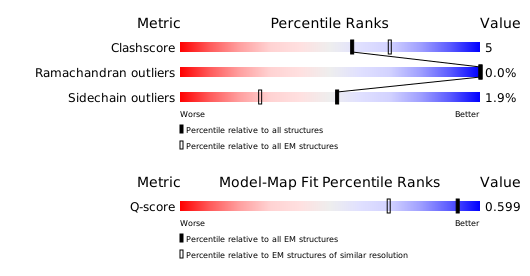
Structure validation
Download full validation report


