






 9NLV
9NLV
Cryo-EM structure of hexameric SenDRT9 RT-ncRNA complex
Summary for 9NLV
| Entry DOI | 10.2210/pdb9nlv/pdb |
| EMDB information | 49523 |
| Descriptor | RNA-dependent DNA polymerase, RNA (147-MER) (2 entities in total) |
| Functional Keywords | drt9, polymerase, immune system |
| Biological source | Escherichia coli More |
| Total number of polymer chains | 12 |
| Total formula weight | 633364.27 |
| Authors | Burman, N.,Pandey, S.,Wiedenheft, B.,Sternberg, S.H. (deposition date: 2025-03-03, release date: 2025-05-14, Last modification date: 2025-08-13) |
| Primary citation | Tang, S.,Zedaveinyte, R.,Burman, N.,Pandey, S.,Ramirez, J.L.,Kulber, L.M.,Wiegand, T.,Wilkinson, R.A.,Ma, Y.,Zhang, D.J.,Lampe, G.D.,Berisa, M.,Jovanovic, M.,Wiedenheft, B.,Sternberg, S.H. Protein-primed homopolymer synthesis by an antiviral reverse transcriptase. Nature, 643:1352-1362, 2025 Cited by PubMed Abstract: Bacteria defend themselves from viral predation using diverse immune systems, many of which target foreign DNA for degradation. Defence-associated reverse transcriptase (DRT) systems provide an intriguing counterpoint to this strategy by using DNA synthesis instead. We and others recently showed that DRT2 systems use an RNA template to assemble a de novo gene that encodes the antiviral effector protein Neo. It remains unclear whether similar mechanisms of defence are used by other related DRT families. Here, we show that DRT9 systems defend against phage using DNA homopolymer synthesis. Viral infection triggers polydeoxyadenylate (poly-dA) accumulation in the cell, driving abortive infection and population-level immunity. Cryo-electron microscopy structures reveal how a non-coding RNA serves as both a structural scaffold and reverse transcription template to direct hexameric complex assembly and poly-dA synthesis. Notably, biochemical and functional experiments identify tyrosine residues within the reverse transcriptase itself that probably prime DNA synthesis, leading to the formation of protein-DNA covalent adducts. Synthesis of poly-dA by DRT9 in vivo is regulated by the competing activities of phage-encoded triggers and host-encoded silencers. Collectively, our study identifies a nucleic-acid-driven defence system that expands the paradigm of bacterial immunity and broadens the known functions of reverse transcriptases. PubMed: 40436039DOI: 10.1038/s41586-025-09179-5 PDB entries with the same primary citation |
| Experimental method | ELECTRON MICROSCOPY (2.6 Å) |
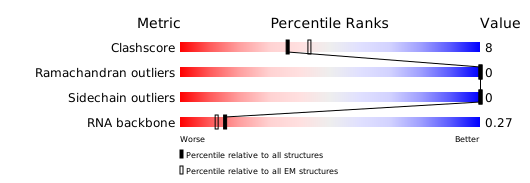
Structure validation
Download full validation report


