






 9NIX
9NIX
FphI, Staphylococcus aureus fluorophosphonate-binding serine hydrolases I, in complex with Carbamoyl Fluoride compound 21
This is a non-PDB format compatible entry.
Summary for 9NIX
| Entry DOI | 10.2210/pdb9nix/pdb |
| Descriptor | Serine aminopeptidase S33 domain-containing protein, (3aR,7aS)-octahydro-2H-isoindole-2-carbaldehyde, CALCIUM ION, ... (4 entities in total) |
| Functional Keywords | inhibitor, carboxylesterase, covalent warhead, carbamoyl fluoride, hydrolase, hydrolase-hydrolase inhibitor complex, hydrolase/hydrolase inhibitor |
| Biological source | Staphylococcus aureus subsp. aureus USA300 |
| Total number of polymer chains | 1 |
| Total formula weight | 27879.50 |
| Authors | Randall, G.T.,Meden, A.,Knez, D.,Fellner, M. (deposition date: 2025-02-26, release date: 2026-04-01, Last modification date: 2026-04-29) |
| Primary citation | Randall, G.,Meden, A.,Rutledge, M.T.,Prestresi, L.,Rambaher, M.H.,Chen, S.,Zdovc, I.,Gobec, S.,Knez, D.,Fellner, M. Carbamoyl fluorides as serine hydrolase inhibitors: a case study on FphI from Staphylococcus aureus. Bioorg.Chem., 176:109834-109834, 2026 Cited by PubMed Abstract: Selective covalent inhibitors have recently gained popularity as potent therapeutic drugs or molecular tools to investigate protein function. Serine hydrolases are a particular class of enzymes involved in diverse diseases. They possess a nucleophilic catalytic serine residue which can be targeted by covalent warheads. Carbamoyl fluoride is a relatively underexplored and underutilized organofluorine warhead. Here, we have designed and screened a focused library of carbamoyl fluoride fragments that successfully inhibited a recently discovered biofilm-associated serine hydrolase, FphI, from the pathogen Staphylococcus aureus. Enzyme kinetics and LC-MS experiments demonstrated that these compounds are potent covalent inhibitors of FphI. Furthermore, two resolved ligand-bound crystal structures further confirm covalent binding to the catalytic serine 94 of FphI, with the warhead carbonyl forming a key interaction at the oxyanion hole and carbamate N-substituents occupying a hydrophobic substrate binding site. These findings expand the medicinal chemist's covalent toolbox to include the carbamoyl fluoride warhead for its further development into chemical probes or covalent inhibitors of clinically relevant serine hydrolases. PubMed: 41965188DOI: 10.1016/j.bioorg.2026.109834 PDB entries with the same primary citation |
| Experimental method | X-RAY DIFFRACTION (1.42 Å) |
Structure validation
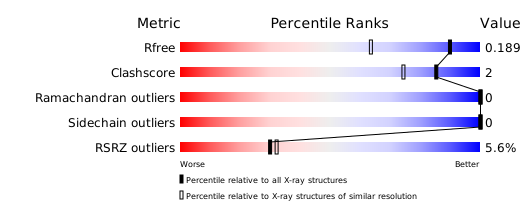
Download full validation report


