






 9NIG
9NIG
PB TCR in complex with HLA-DR4 presenting citrullinated Tenascin C peptide
Summary for 9NIG
| Entry DOI | 10.2210/pdb9nig/pdb |
| Descriptor | HLA class II histocompatibility antigen, DR alpha chain, HLA class II histocompatibility antigen DR beta chain, PB TCR alpha chain, ... (9 entities in total) |
| Functional Keywords | human leukocyte antigen, t cell receptor, citrullinated epitope, rheumatoid arthritis., immune system |
| Biological source | Homo sapiens (human) More |
| Total number of polymer chains | 15 |
| Total formula weight | 289111.49 |
| Authors | Dao, H.T.,Loh, T.J.,Lim, J.J.,Rossjohn, J. (deposition date: 2025-02-26, release date: 2025-05-21, Last modification date: 2025-12-03) |
| Primary citation | Dao, H.T.,Loh, T.J.,Sharma, R.K.,Klareskog, L.,Malmstrom, V.,Reid, H.H.,Rossjohn, J.,Lim, J.J. The molecular basis of T cell receptor recognition of citrullinated tenascin-C presented by HLA-DR4. J.Biol.Chem., 301:110326-110326, 2025 Cited by PubMed Abstract: CD4 T cell autoreactivity against citrullinated (cit) self-epitopes presented by HLA-DRB1 is associated with rheumatoid arthritis (RA) pathogenesis. We understand the molecular bases of T cell receptor (TCR) recognition of cit-fibrinogen, cit-vimentin, and cit-α-enolase epitopes, and the role of citrulline in shaping TCR repertoire usage. Nevertheless, how TCRs recognize other cit-epitopes, including tenascin-C (TNC) and how alternative citrullination positions may modulate the T cell recognition remains unclear. Here, we examined TNC peptide, which contains citrullination at position P-1 and P2, to study the underlying TCR-HLA-DRB104:01-TNC molecular interactions. Crystal structure of HLA-DRB104:01 at 2.4 Å resolution revealed a conserved peptide binding register to the established HLA-DRB104:01-peptide structures, where both citrullines protruded upward. Next, we determined the crystal structure of a RA patient-derived TRAV35/TRBV10-2 (PB) TCR in complex with HLA-DRB104:01 at 3.2 Å resolution. The CDR3α loop (VGNTN) of PB TCR formed a secondary helical conformation at the N-terminus of the peptide binding cleft, allowing extensive interactions between the P-1 and P2 citrullines of TNC peptide. Surface plasmon resonance, tetramer staining, and CD69 activation assays revealed that the PB TCR did not cross-react to other RA autoantigens, and the P-1-Cit, P2-Cit, and P5-Tyr of TNC are the key determinants underlying the strict specificity of the PB TCR. Collectively, we provide molecular insight into citrullination in modulating TCR recognition. PubMed: 40466907DOI: 10.1016/j.jbc.2025.110326 PDB entries with the same primary citation |
| Experimental method | X-RAY DIFFRACTION (3.20008034513 Å) |
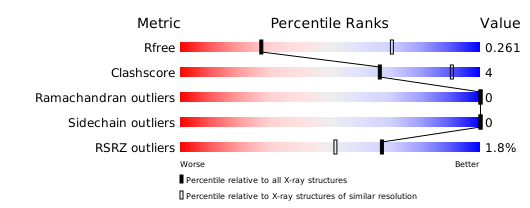
Structure validation
Download full validation report


