






 9NGV
9NGV
In situ cryo-EM structure of periplasmic ring (PR) of the Legionella Dot/Icm T4SS machine.
This is a non-PDB format compatible entry.
Summary for 9NGV
| Entry DOI | 10.2210/pdb9ngv/pdb |
| EMDB information | 49394 |
| Descriptor | unknown peptide A, unknown peptide B, unknown peptide C, ... (7 entities in total) |
| Functional Keywords | type ivb dot/icm secretion machine, protein transport |
| Biological source | Legionella pneumophila subsp. pneumophila More |
| Total number of polymer chains | 126 |
| Total formula weight | 3266500.12 |
| Authors | |
| Primary citation | Yue, J.,Heydari, S.,Park, D.,Chetrit, D.,Tachiyama, S.,Guo, W.,Botting, J.M.,Wu, S.,Roy, C.R.,Liu, J. In situ structures of the Legionella Dot/Icm T4SS identify the DotA-IcmX complex as the gatekeeper for effector translocation. Proc.Natl.Acad.Sci.USA, 122:e2516300122-e2516300122, 2025 Cited by PubMed Abstract: The Dot/Icm machine of is among the most versatile type IV secretion systems (T4SSs), capable of translocating more than 330 distinct effector proteins across the bacterial envelope into host cells. Assembly and function of the system require at least 27 Dot and Icm proteins, yet its architecture and activation mechanism remain poorly understood at the molecular level. Here, we deploy in situ single-particle cryoelectron microscopy to determine near-atomic structures of the Dot/Icm machine and its intimate association with three distinct outer membrane porins in intact bacteria. Notably, two essential yet enigmatic components, DotA and IcmX, form a pentameric protochannel in an inactive state at the central axis of the Dot/Icm machine. Upon Dot/Icm activation with host lysate, this protochannel undergoes extensive rearrangements to generate an extended transenvelope conduit, as visualized by cryoelectron tomography (cryo-ET) and subtomogram averaging. Furthermore, a combination of cryo-ET and cryo-FIB milling of macrophages infected with reveals tethering of the Dot/Icm machine to the host membrane, suggesting direct translocation of effector proteins from the bacterial cytoplasm into the host. Together, our studies identify the DotA-IcmX complex as a gatekeeper for effector translocation and provide a molecular framework for understanding the assembly and activation of the elaborate Dot/Icm T4SS. PubMed: 40986344DOI: 10.1073/pnas.2516300122 PDB entries with the same primary citation |
| Experimental method | ELECTRON MICROSCOPY (3.04 Å) |
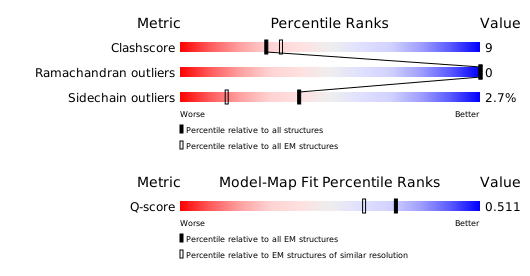
Structure validation
Download full validation report


