






 9NES
9NES
C-terminal mVenues tagged Shaker TM domain in C4 symmetry
Summary for 9NES
| Entry DOI | 10.2210/pdb9nes/pdb |
| EMDB information | 49333 |
| Descriptor | Potassium voltage-gated channel protein Shaker, (2S)-3-(hexadecanoyloxy)-2-[(9Z)-octadec-9-enoyloxy]propyl 2-(trimethylammonio)ethyl phosphate, POTASSIUM ION, ... (4 entities in total) |
| Functional Keywords | voltage-gated potassium channel, membrane protein |
| Biological source | Drosophila melanogaster (fruit fly) |
| Total number of polymer chains | 4 |
| Total formula weight | 326240.10 |
| Authors | Tan, X.,Swartz, K.J. (deposition date: 2025-02-20, release date: 2025-08-06, Last modification date: 2025-10-08) |
| Primary citation | Tan, X.F.,Fernandez-Marino, A.I.,Li, Y.,Chang, T.H.,Swartz, K.J. Structural basis of fast N-type inactivation in K v channels. Nature, 645:1081-1089, 2025 Cited by PubMed Abstract: Action potentials are generated by opening of voltage-activated sodium (Na) and potassium (K) channels, which can rapidly inactivate to shape the nerve impulse and contribute to synaptic facilitation and short-term memory. The mechanism of fast inactivation was proposed to involve an intracellular domain that blocks the internal pore in both Na and K channels; however, recent studies in Na and K channels support a mechanism in which the internal pore closes during inactivation. Here we investigate the mechanism of fast inactivation in the Shaker K channel using cryo-electron microscopy, mass spectrometry and electrophysiology. We resolved structures of a fully inactivated state in which the non-polar end of the N terminus plugs the internal pore in an extended conformation. The N-terminal methionine is deleted, leaving an alanine that is acetylated and interacts with a pore-lining isoleucine residue where RNA editing regulates fast inactivation. Opening of the internal activation gate is required for fast inactivation because it enables the plug domain to block the pore and repositions gate residues to interact with and stabilize that domain. We also show that external K destabilizes the inactivated state by altering the conformation of the ion selectivity filter rather than by electrostatic repulsion. These findings establish the mechanism of fast inactivation in K channels, revealing how it is regulated by RNA editing and N-terminal acetylation, and providing a framework for understanding related mechanisms in other voltage-activated channels. PubMed: 40770100DOI: 10.1038/s41586-025-09339-7 PDB entries with the same primary citation |
| Experimental method | ELECTRON MICROSCOPY (2.67 Å) |
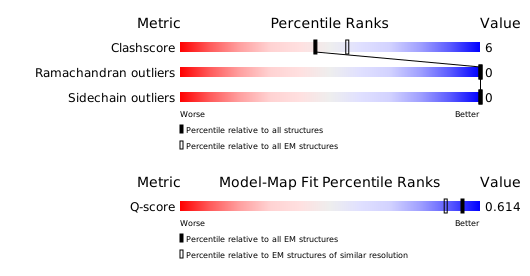
Structure validation
Download full validation report


