






 9NE4
9NE4
cryoEM structure of the A-chain of the human OGA-L Catalytic Dimer
Summary for 9NE4
| Entry DOI | 10.2210/pdb9ne4/pdb |
| EMDB information | 49293 49294 |
| Descriptor | Protein O-GlcNAcase (1 entity in total) |
| Functional Keywords | o-glcnac, histones, dna repair, dna damage, transcription, epigenetics, hydrolase |
| Biological source | Homo sapiens (human) |
| Total number of polymer chains | 1 |
| Total formula weight | 103020.91 |
| Authors | Nyenhuis, S.B.,Steenackers, A.,Hinshaw, J.E.,Hanover, J.A. (deposition date: 2025-02-19, release date: 2025-12-24, Last modification date: 2026-01-14) |
| Primary citation | Nyenhuis, S.B.,Steenackers, A.,Mukherjee, M.M.,Hinshaw, J.E.,Hanover, J.A. Human O-GlcNAcase catalytic-stalk dimer anchors flexible histone binding domains. Commun Chem, 9:8-8, 2025 Cited by PubMed Abstract: Although thousands of proteins are specifically O-GlcNAc modified, the molecular features recognized by the enzymes of O-GlcNAc cycling (OGT/OGA) remain poorly defined. Here we solved the structure of the long isoform of human OGA (OGA-L) by cryo-electron microscopy (cryo-EM) providing a physiologically relevant platform to study the enzyme. The catalytic-stalk dimer structure was solved to a resolution of 3.63 Å, and the locally refined OGA A- and B-chains to 2.98 Å and 3.05 Å respectively. Intriguingly, the cryo-EM structures also exhibit lower resolution densities associated with the pHAT domains, suggesting substantial flexion of these domains relative to the catalytic-stalk dimer. OGA-L binds to a small subset of the 384 modified histone tails on a commercial histone peptide array. High affinity binding of OGA-L was detected to recombinant DNA-containing mononucleosomes bearing the H3K36 and H4K modifications. The OGA-L-H3K36 interaction was further validated by traditional ChIP experiments in MEFs. Thus, OGA-L binds to two modified histone tails of nucleosomes linked to open chromatin, whereas it does not bind to marks associated with repressive chromatin. This model is consistent with OGA-L acting as a 'reader' of histone modifications linked to development, transcriptional activation, transposon silencing, and DNA damage repair. PubMed: 41366547DOI: 10.1038/s42004-025-01813-7 PDB entries with the same primary citation |
| Experimental method | ELECTRON MICROSCOPY (2.98 Å) |
Structure validation
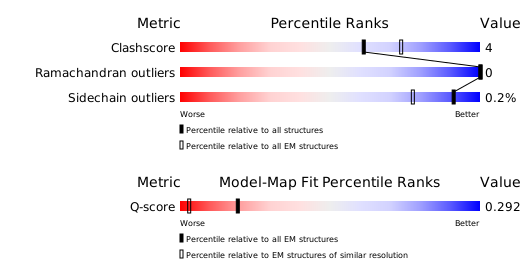
Download full validation report


