






 9N1A
9N1A
crystal structure of diferric HrmI from Streptomyces griseoflavus
Summary for 9N1A
| Entry DOI | 10.2210/pdb9n1a/pdb |
| Descriptor | HrmI, FE (III) ION, GLYCEROL, ... (4 entities in total) |
| Functional Keywords | metalloenzyme, oxygenase, diiron, oxidoreductase |
| Biological source | Streptomyces griseoflavus |
| Total number of polymer chains | 1 |
| Total formula weight | 41225.79 |
| Authors | Skirboll, S.S.,Phan, H.N.,Makris, T.M.,Swartz, P.D. (deposition date: 2025-01-24, release date: 2025-08-20, Last modification date: 2025-08-27) |
| Primary citation | Skirboll, S.S.,Gangopadhyay, M.,Phan, H.N.,Hartsell, J.,Mudireddy, A.,Hilovsky, D.,Swartz, P.D.,Liu, X.,Guo, Y.,Makris, T.M. The Heme Oxygenase-Like Diiron Enzyme HrmI Reveals Altered Regulatory Mechanisms for Dioxygen Activation and Substrate N-Oxygenation. J.Am.Chem.Soc., 147:30210-30221, 2025 Cited by PubMed Abstract: Nonheme diiron enzymes activate dioxygen (O) to affect various biochemical outcomes. HrmI, a member of the recently discovered and functionally versatile heme oxygenase-like dimetal oxidase/oxygenase (HDO) superfamily, catalyzes the N-oxygenation of L-Lysine to yield 6-nitronorleucine for the biosynthesis of the antibiotic hormaomycin. Unlike other characterized HDO N-oxygenases that have an additional carboxylate ligand thought to be key for regulating dioxygen activation and ensuing N-oxygenation, the predicted primary coordination sphere of HrmI resembles those of HDOs that instead perform C-C fragmentation of substrates. We show that diferrous HrmI reacts with O in a substrate-independent manner to form a presumptive μ-1,2 (Fe) peroxo (or ) intermediate common to the catalytic scheme of many HDOs. is rapidly converted to a second species with both optical and Mössbauer properties that resemble an activated peroxodiferric adduct (). The substrate-dependent acceleration of decay suggests that it, rather than , initiates l-Lysine metabolism. X-ray crystallographic studies of HrmI in several redox and ligand-bound states provide a stepwise view of structural changes during catalysis and, together with analytical approaches, capture a hydroxylamino metabolic intermediate en route to 6-nitronorleucine formation. The activation of peroxo species provides a key strategy that enables functional adaptation within the widely distributed HDO structural scaffold. PubMed: 40774922DOI: 10.1021/jacs.5c08814 PDB entries with the same primary citation |
| Experimental method | X-RAY DIFFRACTION (2.13 Å) |
Structure validation
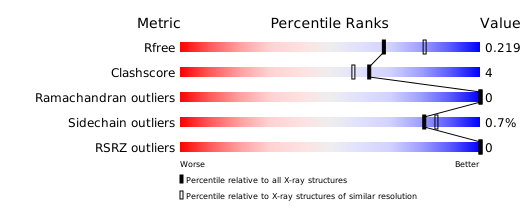
Download full validation report


