






 9MUC
9MUC
Human IMPDH2 mutant - S160del, treated with GTP, ATP, IMP, and NAD+; interfacial octamer reconstruction
Summary for 9MUC
| Entry DOI | 10.2210/pdb9muc/pdb |
| Related | 9MUB |
| EMDB information | 48627 48628 |
| Descriptor | Inosine-5'-monophosphate dehydrogenase 2, INOSINIC ACID, NICOTINAMIDE-ADENINE-DINUCLEOTIDE (3 entities in total) |
| Functional Keywords | dehydrogenase, purine biosynthesis, oxidoreductase |
| Biological source | Homo sapiens (human) |
| Total number of polymer chains | 8 |
| Total formula weight | 459240.42 |
| Authors | O'Neill, A.G.,Kollman, J.M. (deposition date: 2025-01-13, release date: 2025-12-03, Last modification date: 2026-06-17) |
| Primary citation | O'Neill, A.G.,McCartney, M.E.,Wheeler, G.M.,Patel, J.H.,Sanchez-Ramirez, G.,Kollman, J.M.,Wills, A.E. An IMPDH2 variant associated with neurodevelopmental disorder disrupts purine biosynthesis and somite organization. Proc.Natl.Acad.Sci.USA, 122:e2511727122-e2511727122, 2025 Cited by PubMed Abstract: IMP dehydrogenase (IMPDH) controls a key regulatory node in purine biosynthesis. Gain-of-function mutations in human IMPDH2 are associated with neurodevelopmental disorders and neuromuscular symptoms including dystonia, but the developmental mechanisms underlying these defects are unknown. We previously showed that these mutants are insensitive to GTP inhibition and hypothesized that their hyperactivity would affect nucleotide metabolism in vivo. Here, we characterize the metabolic and developmental consequences of the neurodevelopmental disorder-associated IMPDH2 mutant, S160del, in . We show that expressing S160del but not WT human IMPDH2 disrupts purine pools and somite organization in the developing tadpole. We also show that S160del disrupts in vivo IMPDH filament assembly, a well-described IMPDH regulatory mechanism. Cryo-EM structures show that S160del disrupts filament assembly by destabilizing the dimerization of regulatory Bateman domains. Dimerization of Bateman domains and subsequent filament formation can be restored with a high affinity ligand, but this does not restore sensitivity to GTP inhibition, suggesting S160del also disrupts allostery of IMPDH2 filaments. This work demonstrates that the structural effects of patient IMPDH2 variants can cause disruptions both to nucleotide levels and to the normal development of sensorimotor structures, helping us better understand the physiological basis of disease in these patients. PubMed: 41343675DOI: 10.1073/pnas.2511727122 PDB entries with the same primary citation |
| Experimental method | ELECTRON MICROSCOPY (2.1 Å) |
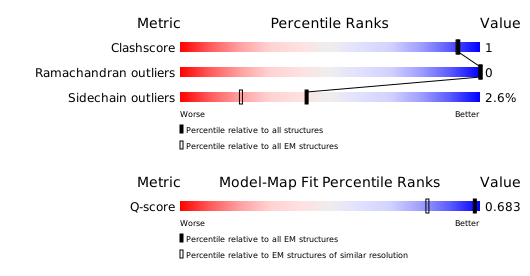
Structure validation
Download full validation report


