






 9MT8
9MT8
Cryo-EM structure of the human TRPM4 channel in a calcium bound putative desensitized state
Summary for 9MT8
| Entry DOI | 10.2210/pdb9mt8/pdb |
| Related | 9MRT |
| EMDB information | 48563 48603 |
| Descriptor | Transient receptor potential cation channel subfamily M member 4, CALCIUM ION (2 entities in total) |
| Functional Keywords | trpm4, ion channel, transport protein |
| Biological source | Homo sapiens (human) |
| Total number of polymer chains | 4 |
| Total formula weight | 537986.25 |
| Authors | Teixeira-Duarte, C.M.,Jiang, Y. (deposition date: 2025-01-10, release date: 2025-10-29, Last modification date: 2026-02-04) |
| Primary citation | Teixeira-Duarte, C.M.,Zeng, W.,Jiang, Y. Structural landscape of activation, desensitization and inhibition in the human TRPM4 channel. Nat.Struct.Mol.Biol., 33:43-52, 2026 Cited by PubMed Abstract: TRPM4 is a member of the transient receptor potential melastatin channel subfamily and functions as a Ca-activated monovalent-selective cation channel. It is widely expressed in various cells and tissues, where its activation depolarizes the plasma membrane potential and modulates various Ca-dependent biological processes. TRPM4 activity is potentiated by membrane phosphatidylinositol 4,5-bisphosphate (PtdIns(4,5)P) and inhibited by cytosolic free adenosine triphosphate (ATP), allowing the channel to transition between different functional states in response to dynamic changes in cellular Ca, ATP and PtdIns(4,5)P levels during signaling events. Here we present single-particle cryo-electron microscopy structures of human TRPM4 in four distinct states: apo closed, Ca-bound putative desensitized, Ca-PtdIns(4,5)P-bound open and ATP-bound inhibited. Combined with mutagenesis and electrophysiological analyses, these structures reveal the molecular mechanisms underlying TRPM4 activation, desensitization and inhibition. Given the central roles of Ca, PtdIns(4,5)P and ATP in cellular signaling, this work provides a structural foundation to decipher the physiological functions of TRPM4 across diverse biological systems. PubMed: 41174278DOI: 10.1038/s41594-025-01705-3 PDB entries with the same primary citation |
| Experimental method | ELECTRON MICROSCOPY (3.19 Å) |
Structure validation
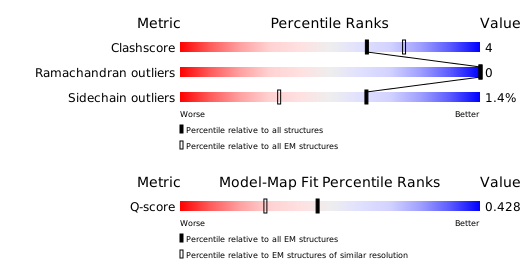
Download full validation report


