






 9MNG
9MNG
Band 3 OF/OF
Summary for 9MNG
| Entry DOI | 10.2210/pdb9mng/pdb |
| EMDB information | 48422 |
| Descriptor | Band 3 anion transport protein, 2-acetamido-2-deoxy-beta-D-glucopyranose-(1-4)-[alpha-L-fucopyranose-(1-6)]2-acetamido-2-deoxy-beta-D-glucopyranose, [(2R)-2-octanoyloxy-3-[oxidanyl-[(1R,2R,3S,4R,5R,6S)-2,3,6-tris(oxidanyl)-4,5-diphosphonooxy-cyclohexyl]oxy-phosphoryl]oxy-propyl] octanoate, ... (5 entities in total) |
| Functional Keywords | membrane protein, transorter, chloride, bicarbonate, pip2, red blood cell, transport protein |
| Biological source | Homo sapiens (human) |
| Total number of polymer chains | 2 |
| Total formula weight | 207298.27 |
| Authors | Vallese, F.,Kim, K.,Clarke, O.B. (deposition date: 2024-12-21, release date: 2025-12-10, Last modification date: 2026-01-14) |
| Primary citation | Chen, T.,Vallese, F.,Gil-Iturbe, E.,Kim, K.,Cali, T.,Quick, M.,Clarke, O.B.,Tajkhorshid, E. Impact of anionic lipids on the energy landscape of conformational transition in anion exchanger 1 (AE1). Nat Commun, 16:11664-11664, 2025 Cited by PubMed Abstract: Anion Exchanger 1 (AE1) is an elevator-type transporter that plays a key role in acid-base homeostasis of erythrocytes. Here, we report three high-resolution cryo-electron microscopy (cryo-EM) structures of distinct states of AE1: two inward-facing (IF1 and IF2) and one outward-facing (OF). Uptake assay revealed the modulatory effect of phosphatidylinositol 4,5-bisphosphate (PIP) lipids on AE1. Molecular dynamics simulations are conducted on these structures to determine the anion binding sites in AE1. We then use advanced enhanced sampling to study the OF⇌IF transition in AE1 in three systems: apo, HCO-bound, and an AE1 system in which cryo-EM-determined PIP lipids had been removed. The transition pathways were then used to calculate the free energy of the OF⇌IF transition in AE1 under different conditions. The results show how substrate reduces the transition barrier against transport. Furthermore, they capture the inhibitory effect of PIP lipids and provide a molecular mechanism for this inhibitory effect. PubMed: 41298479DOI: 10.1038/s41467-025-66786-6 PDB entries with the same primary citation |
| Experimental method | ELECTRON MICROSCOPY (3.11 Å) |
Structure validation
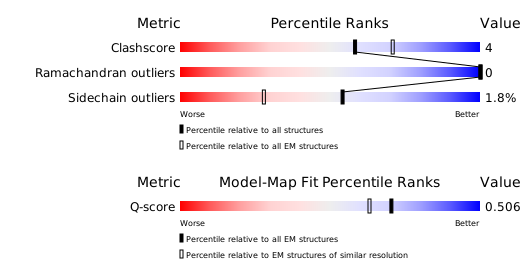
Download full validation report


