






 9MLF
9MLFSummary for 9MLF
| Entry DOI | 10.2210/pdb9mlf/pdb |
| Descriptor | Tubulin alpha-1B chain, Tubulin beta chain, Stathmin-4, ... (9 entities in total) |
| Functional Keywords | microtubule inhibitor, colchicine, cell cycle, cancer, cell cycle inhibitor complex, structural protein-inhibitor complex, structural protein/inhibitor |
| Biological source | Rattus norvegicus (Norway rat) More |
| Total number of polymer chains | 5 |
| Total formula weight | 214516.59 |
| Authors | |
| Primary citation | Albadari, N.,Xie, Y.,Wang, Q.,Miller, D.J.,Gruntz, J.Q.,Oldham, M.L.,Chen, H.,Ma, D.,Wu, Z.,Miller, D.D.,Li, W. Design and synthesis of novel 4-aryl-2-benzoyl-imidazoles as colchicine binding site inhibitors. Eur.J.Med.Chem., 298:118021-118021, 2025 Cited by PubMed Abstract: Highly potent tubulin inhibitors serve as critical payloads in several FDA-approved antibody-drug conjugates (ADCs). However, all these compounds are natural products with complex structures, which limit the ability to adjust their physicochemical properties for the optimal balance between payload release and ADC stability during systemic circulation, as well as efficient tumor penetration. Although taxanes are widely used in cancer therapy, they are unsuitable for ADCs due to insufficient potency and a high tendency to develop acquired drug resistance. Colchicine binding site inhibitors (CBSIs) are attractive alternatives, offering tunable properties and the potential to overcome multidrug resistance associated with the use of many existing tubulin inhibitors. However, most CBSIs lack sufficient potency for viable ADC applications. In our pursuit of a highly potent CBSI suitable for ADC use, we identified a novel series of sabizabulin derivatives. These compounds were evaluated in vitro across four cancer cell lines, including one with high resistance to taxanes. Among them, compound 11b emerged as the most promising one with IC values ranging from 0.6 nM to 1.3 nM in cancer cells, entering the potency range as a potential ADC payload. Importantly, 11b also effectively overcame taxane-associated drug resistance. Mechanistic studies confirmed that 11b directly binds to the colchicine site on tubulin, as demonstrated by its high-resolution crystal structure in a complex with tubulin protein. In vivo efficacy studies using a taxane-resistant prostate cancer xenograft model (PC-3/TxR) revealed that 11b significantly suppressed tumor growth, disrupted angiogenesis, and induced apoptosis. Together, these findings highlight 11b as a highly potent CBSI with the capability of overcoming acquired drug resistance to taxanes, suggesting its strong potential as a next-generation ADC payload. PubMed: 40763661DOI: 10.1016/j.ejmech.2025.118021 PDB entries with the same primary citation |
| Experimental method | X-RAY DIFFRACTION (2.4 Å) |
Structure validation
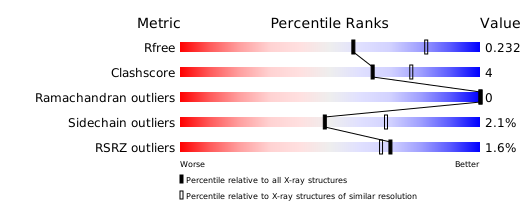
Download full validation report


