






 9M7U
9M7U
At S1+tRNA trimer
Summary for 9M7U
| Entry DOI | 10.2210/pdb9m7u/pdb |
| EMDB information | 63693 |
| Descriptor | S-type anion channel SLAH1, RNA (75-MER) (2 entities in total) |
| Functional Keywords | at s1+trna trimer, membrane protein/rna, membrane protein-rna complex |
| Biological source | Arabidopsis thaliana (thale cress) More |
| Total number of polymer chains | 4 |
| Total formula weight | 154444.25 |
| Authors | |
| Primary citation | Zhang, S.,Huang, X.,Wang, X.,Qi, B.,Yang, K.,Liu, C.,Li, R.,Chen, X.,Yi, J.,Yin, J.,Chen, M.,Liu, B.,Fan, J.,Liu, T.,Hao, Z.,Cui, K.,Xiao, N.,Song, Y.,Li, Y.,Wu, D.,Qi, T.,Mao, J.,Zhang, B.,Yang, M.,Xie, J.,Liu, Z. Structural insights into the coordinated regulation of the SLAH family in Arabidopsis thaliana. Nat Commun, 17:585-585, 2025 Cited by PubMed Abstract: S-type anion channel homologs (SLAH) are widely expressed in various plant tissues and play a key role in anion transport, which is crucial for plant adaptation to both biotic and abiotic stresses. In this study, we employ cryo-electron microscopy (cryo-EM) to analyze four SLAH channel complexes from Arabidopsis thaliana: the homotrimeric SLAH3 channel, the 2SLAH1 + SLAH3+tRNA complex, the 1SLAH1 + 2SLAH3 complex, and the 3SLAH1+tRNA complex. Critically, our studies reveal that tRNA directly binds to and occupies the intracellular entrance of the SLAH1 homotrimer and the 2SLAH1 + SLAH3 heterocomplex. Electrophysiological experiments confirm tRNA's role as a potent inhibitory regulatory subunit: RNase-mediated tRNA degradation robustly activates SLAH1 currents, while targeted mutagenesis of SLAH1 tRNA-interacting residues phenocopy this activation and enhanced ABA-induced stomatal closure. Combining with structural biology, electrophysiology, and biochemistry, we comprehensively examine the key residues in SLAH1 and SLAH3 that are responsible for the anion permeation. This mechanistic advancement provides a deeper understanding of the molecular basis for plant stress tolerance and identifies specific molecular targets for future engineering crops. PubMed: 41407702DOI: 10.1038/s41467-025-67283-6 PDB entries with the same primary citation |
| Experimental method | ELECTRON MICROSCOPY (3.18 Å) |
Structure validation
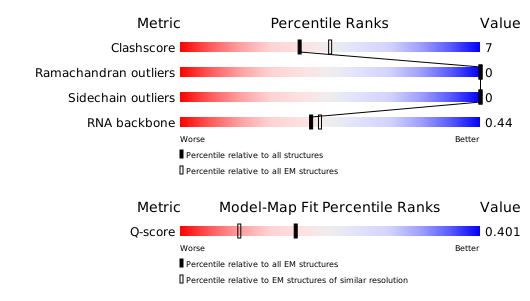
Download full validation report


