






 9M6P
9M6P
Discovery of a bifunctional PKMYT1-targeting PROTAC empowered by AI-generation
This is a non-PDB format compatible entry.
Summary for 9M6P
| Entry DOI | 10.2210/pdb9m6p/pdb |
| Descriptor | Membrane-associated tyrosine- and threonine-specific cdc2-inhibitory kinase, 2,4-dimethyl-3-[2-(2-methylpyrimidin-5-yl)-1~{H}-pyrrolo[2,3-b]pyridin-5-yl]phenol, PHOSPHATE ION, ... (5 entities in total) |
| Functional Keywords | pkmyt1, inhibitor, crystal, protein binding |
| Biological source | Homo sapiens (human) |
| Total number of polymer chains | 2 |
| Total formula weight | 69882.43 |
| Authors | Yazhou, W.,Chao, W. (deposition date: 2025-03-07, release date: 2025-11-05, Last modification date: 2025-12-17) |
| Primary citation | Wang, Y.,Wang, X.,Liu, T.,Wang, C.,Meng, Q.,Meng, F.,Yu, J.,Liu, J.,Fan, Y.,Gennert, D.,Pun, F.W.,Aliper, A.,Ren, F.,Zhang, M.,Cai, X.,Ding, X.,Zhavoronkov, A. Discovery of a bifunctional PKMYT1-targeting PROTAC empowered by AI-generation. Nat Commun, 16:10759-10759, 2025 Cited by PubMed Abstract: PKMYT1 has recently emerged as a compelling therapeutic target for precision cancer therapy due to its synthetic lethality with oncogenic alterations such as CCNE1 amplification and mutations in FBXW7 and PPP2R1A. Current small molecule PKMYT1 inhibitors face limitations, such as insufficient molecular diversity and poor selectivity. We herein use our generative AI platform to develop a bifunctional PKMYT1 degrader by linking an entirely novel PKMYT1 inhibitor to an optimized cereblon (CRBN) binder. The lead PROTAC D16-M1P2 demonstrates dual mechanisms of PKMYT1 degradation and inhibition, with strong antiproliferative potency facilitated by high selectivity. It also exhibits favorable oral bioavailability, stronger pharmacodynamic effects relative to the PKMYT1 inhibitor alone, and robust antitumor response as a monotherapy in xenograft models. This PROTAC serves as a precise chemical probe to explore PKMYT1 biology and a promising lead for further cancer therapy exploration. PubMed: 41315240DOI: 10.1038/s41467-025-65796-8 PDB entries with the same primary citation |
| Experimental method | X-RAY DIFFRACTION (2.383 Å) |
Structure validation
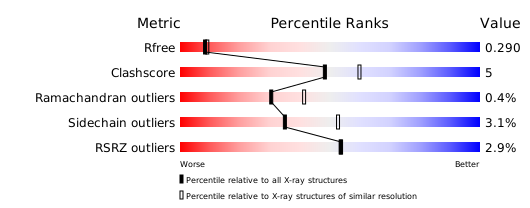
Download full validation report


